
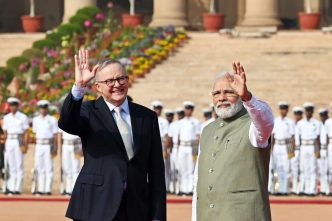
Deepening strategic and defence cooperation with India is one of Australia’s regional priorities, as Prime Minister Anthony Albanese’s recent visit to India clearly demonstrated. As we seek to build our cooperation in ways that benefit …

Deepening strategic and defence cooperation with India is one of Australia’s regional priorities, as Prime Minister Anthony Albanese’s recent visit to India clearly demonstrated. As we seek to build our cooperation in ways that benefit …
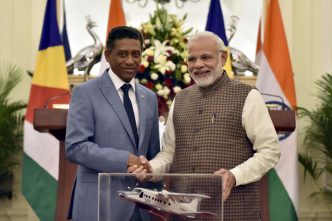
Seeking to shape public opinion has long been part of diplomatic checklists the world over. In the context of an increasingly assertive China, Australia and others have had to think much harder about their own …

China’s campaign of economic coercion against Australia failed because of support from other Asian trading partners who turned to Australia to secure their energy supplies. Japan, Korea, Taiwan and India—Australia’s second, third, fourth and fifth …
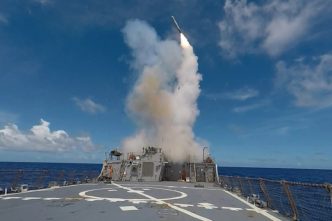
In the following edited transcript from proceedings at ASPI’s Sydney Dialogue, Michael Pezzullo, secretary of the Department of Home Affairs, interviews Eric Schmidt, chair of the Special Competitive Studies Project, co-founder of Schmidt Futures and …

Late last year, Morris Chang, the legendary founder of Taiwan’s (and the world’s) leading semiconductor producer, proclaimed: ‘Globalisation is almost dead.’ In a world where supply chains have been disrupted by Covid-19 and the deepening …

The geostrategic scramble to reduce supply-chain dependencies for critical minerals has overshadowed opportunities for Australia to use its resources to provide major benefits for the nation. There are clear and achievable pathways for downstream processing …
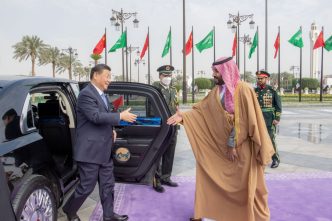
As Pax Americana has eroded in the Middle East over the years, Beijing has been availed of a unique opportunity to expand its influence in the region. China has grown in stature as not only a reliable …
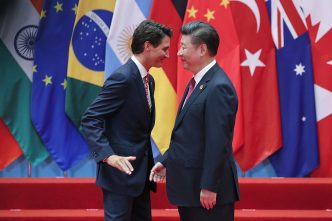
The Canadian government released its highly anticipated Indo-Pacific strategy last weekend. It commits the government to spending C$2.3 billion over five years to expand Canada’s military, security, trade and diplomatic ties with Indo-Pacific countries and …

The Ukraine conflict is exposing the massive costs that accompany a relatively small and contained war—one in which the military action is entirely confined to one of the poorest nations in Europe. Although Ukraine has …

In addition to dealing with the fallout from open warfare in eastern Europe, the world is witnessing the start of a full-scale economic war between the United States and China over technology. This conflict will …

Last month, UN member states elected American candidate Doreen Bogdan-Martin as the next secretary-general of the International Telecommunications Union in a fiercely contested diplomatic battle against a Russian candidate (and former executive of Chinese technology …

On 29 September, member states of the International Telecommunications Union voted to elect Doreen Bogdan-Martin as the organisation’s next secretary-general. Bogdan-Martin—a US national who’s served in the ITU since 1994—was in contention for the top …