
Defence White Paper 2013

Four principles of Australian defence policy

LCPL Dustin Hoppe from Melbourne’s 4th/19th Prince of Wales Light Horse Regiment stands at Rest on Arms as a member of the Catafalque Party during the Dawn Service in Honiara, Solomon Islands.I’m an old Defence-of-Australia hand, so I’ll offer a perspective which looks at the 2013 Defence White Paper through that prism, and then draw some conclusions.

There are four overall principles that have characterised Defence of Australia policies. The first is the self-reliant Defence of Australia. The new White Paper leaves no equivocation on this point.  Paragraph 3.35 says ‘The highest priority ADF task is to deter or defeat armed attacks on Australia without having to rely on the combat or combat support forces of another country’. The next paragraph elaborates:  ‘Australia’s defence policy is founded on the principle of self-reliance in deterring or defeating armed attack on Australia, within the context of our Alliance with the United States and our cooperation with regional partners’. What’s new here is the reference to the region in the final phrase.

The second policy principle is that there are limits to Australia’s military resources and influence. There are few direct references to this (perhaps it’s taken as self-evident) but there’s little doubt that it’s a central factor.  Paragraph 3.2 reads to the effect that the Government’s responses to security threats and opportunities will have to acknowledge ‘the limits of our capability and reach’. The next sentence is in some ways more telling:  ‘Choices must therefore be made to guide the allocation of finite resources to deal with challenges that are most likely or most dangerous, and where our response can be most effective’. This theme of choice, and by implication difficult choice, recurs throughout the document:  see for example paragraph 7.9. Read more

A related theme is that Australia’s strategic edge is likely to diminish. For example, paragraph 2.51 says ‘Over the next three decades, Australia’s relative strategic weight will be challenged as the major Asian states continue to grow their economies and modernise their military forces’. This thought too recurs in the White Paper.

The third principle is the strong preference for operations closer to home over more-distant operations. Paragraphs 3.30 to 3.34 spell this out most clearly, with Task 1 (deter and defeat armed attacks on Australia) and Task 2 (contribute to stability and security in the South Pacific and Timor-Leste) being the determinants of the force structure, and with the resultant defence force being deemed sufficient to meet the needs of Tasks 3 and 4 (contribute to military contingencies elsewhere, with priority given to Southeast Asia). This is classic Defence of Australia stuff, although other parts of the text seem to allow for a greater influence of operations in the nearer reaches of the Indo-Pacific (a new term introduced in this white paper) than previously.

The fourth principle brings together the issues of levels of contingency (and discretion), warning time, and force expansion. Recall the Defence of Australia approach: minor contingencies were credible in the shorter term, but major contingencies would be credible only after an extended period of warning, during which Defence would expand.

With respect to major contingencies, not a lot has changed. Paragraph 5.13 talks of the need to balance resources between current and short-term requirements while retaining a baseline as the foundation for force expansion should strategic circumstances deteriorate. Paragraphs 3.39 and 3.40 elaborate on this, including the need for strong defence intelligence. Paragraph 3.46 reassures us that, in spite of military modernisation in our region, we would still expect substantial warning of a major power attack, although, perversely, paragraph 7.12 cautions that strategic circumstances can change with little warning.

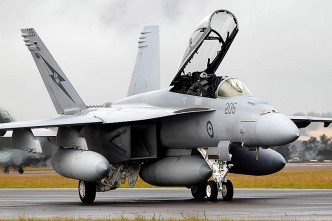
In any event, there’s little force expansion on offer, implying that we’re not in a period of strategic warning. Nevertheless, the commitment to get twelve electronic warfare Growler Super Hornets is important, as is the enhancement of cyber security. Overall, more needs to be done on the analysis behind warning and expansion, as the issue is critical.

The White Paper is less clear on contingencies to which Australia might want to respond in the shorter term. But preparedness is a recurring theme:  paragraph 5.1 recognises it as a ‘key strategic management tool’, and paragraph 5.17 mentions some welcome recent enhancements to Defence’s preparedness management system. Paragraph 5.3 is a cautionary straw in the wind:  ‘Adjustments to preparedness levels … can take effect relatively quickly compared to longer-term basing and force structure decisions’. The discussion of the Reserves (paragraphs 4.32 and 5.18 for example) and how quickly they can be readied for either longer-term or shorter-term contingencies seems incomplete. Overall, the issue of what Defence needs to be prepared for, why, and with what warning, is shaping up to be a battle in itself, and, again, more thought is needed.

To paraphrase Thucydides, White Papers are an armistice in the never-ending war for funding:  they set the rules of engagement for the next few rounds of combat between spending departments and the gatekeepers:  they don’t set out the answers, but they do tell you how to ask consistent questions, and in a way agreed by the other players in national security.  They help progress the inevitable unfinished business.

The White Paper contains a lot of the latter. Further examples include the evolution of the ‘Indo-Pacific Strategic Arc’, Defence diplomacy in the region, and Defence policy for industry and innovation. In the immediate term, however, there’s a pressing need to choose the balance of investment between the current force, its preparedness, and modernisation. For choose read adjust and rebalance. It seems unlikely that Defence can afford to modernise what it has already got, so something has to give. Even if the Government continues to maintain the permanent ADF at about 59,000, there’s still the issue of the size of the post-Afghanistan Army and the allocation of the 59,000 between the three Services. Hard decisions usually don’t make themselves:  let’s hope that Defence has the mechanisms in place to identify what needs to be done and then to get on with it.

Richard Brabin-Smith is a visiting fellow at the Strategic and Defence Studies Centre at the Australian National University. Image courtesy of Defence.

Self-reliance and the DWP13

17 May 2013

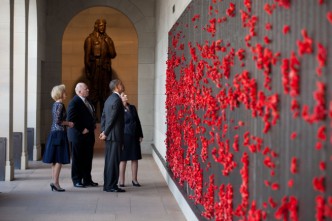
President Barack Obama tours the Australian War Memorial with Governor-General Quentin Bryce, War Memorial Chairman Peter Cosgrove, and Prime Minister Julia Gillard in Canberra, Australia, Nov.17, 2011.Thankfully, Minister Smith has delivered the sort of Defence White Paper you hope for when you really don’t need a White Paper and there isn’t enough money to pay for the current plans, let alone any further promises. Nevertheless, the 2013 White Paper has at least attempted to repair the damage caused to our relationship with China by the Rudd hedging excursion in the 2009 paper. The Chinese must be getting confused by now.

On a positive note, the paper encouragingly hints at Defence acknowledging that it’s part of the broader Australian national security community and it finally introduces some clarity into the submarine question. However, the Air Force must be dreading the prospect of a mixed fleet of combat aircraft—and just when does the number of Super Hornets being purchased start to discount the number of JSF we intend to buy? The paper also makes positive moves towards real policies for cyber and space and finally recognises the importance of Indonesia as a partner in Australia’s security.

The paper’s conservative nature should be seen as a win for the realists in the Department of Defence over the narrow strategic view and spin-obsessed approach of the politicians. Well done to the CDF and the Secretary, who must have had a real battle on their hands to get this result. But the battle isn’t over. Now the Department has to continue the struggle to restore the defence budget to a figure in excess of 2% of GDP before some of the damage that’s already been done to defence capability becomes irreversible. Sadly recent comments from the Federal Opposition provide no hope that they will ride to the rescue. Read more

Away from the bells and whistles of military equipment the White Paper offers a very important discussion on self-reliance. This introduces a reality not evident in previous documents. Past Defence White Papers trumpeted self-reliance as the foundation of our defence. Australia claimed the ability to; act independently, lead military coalitions and make tailored contributions to other activities. Acting independently has always been a fantasy and this White Paper confirms the inevitable; Australia alone can’t defend itself. As a result, we’re a less sovereign nation and severely restrained in making and taking independent decisions and actions. We’ll have to learn how to live with this reality.

The White Paper speaks bravely of our efforts to defend ourselves to the greatest extent possible but acknowledges in the ‘extreme’ we’d depend on direct support from allied combat forces (read America). This presumes they’re willing and able to provide the support.

The important word on the discussion of self-reliance is ‘extreme’. Given the size and nature of our defence force and the deep penetration of US military equipment into the ADF there’s actually very little that Australia could do without US support. It might not be boots on the ground but intelligence, logistic, materiel and technical support will be required for almost any level of conflict. East Timor in 1999 is a classic example. Yes we own the ships and planes, but in reality they can’t operate without the source codes and constant updates of software, navigation and targeting information only available from the US They also need ammunition and maintenance, mostly US sourced. What if the Americans need it themselves for higher priority conflicts or decide not to make it available to us?

The relationship between Australia and America is strong and has worked to the mutual benefit of both countries. It’s hard to imagine a situation where America wouldn’t support Australia (and vice versa) but in the realm of sovereign nations there’s always the potential for divergent national interests. The US and Australia pursued different interests over Irian Jaya in the 1960s and the American view prevailed over ours.

The 2013 White Paper has correctly, if somewhat disingenuously, identified the scale of the problem of Australia achieving military self-reliance. But it is not just ‘extreme’ events where we’d need support. There are very few military situations where Australia could operate independently. The White Paper has done us a favour by highlighting the problem.

Another angle on self-reliance is ensuring that US support will always be available has become an important element of our decision making processes. This involves our interpretation of ANZUS and what some people call making ‘down payments on our defence insurance policy’—US support and involvement when we need it. Are we to make decisions based on our values and sovereign national interests or because we’re concerned that if we don’t help the US in every situation they won’t turn up when we need them?

Another more recent example of restricting our independence is outsourcing decision making. The embedding of HMAS Sydney in the US Seventh Fleet brings Australia closer to conflict in Asia. If conflict broke out in North Korea, Taiwan or in the China Seas it would be difficult for Sydney to avoid being involved. Decisions made by the US to become involved in hostilities will be measured, but do we really want to be involved in the front row of Asian conflict when some of the decisions will be taken by politicians in other nations primed on nationalism and an inability to negotiate in a sensible and constructive manner?

The Defence White Paper of 2013 has given us reason to talk about self-reliance. It’s important that we begin the discussion. For those who don’t like the White Paper, there’s every chance there’ll soon be a new one under a Liberal Government. Sadly, with no firm commitment to a funding increase from them we can’t really expect anything much different from this one.

Peter Leahy is the Director of the National Security Institute at the University of Canberra. He was Chief of Army from 2002 to 2008. Image courtesy of The White House.

Africa and the Defence White Paper

16 May 2013

A rare 1818 map of the Eastern Hemisphere by John Pinkerton. Depicts Asia, Europe, Africa and Australia.For the first time, the most recent Defence White paper contained  multiple references to Africa, illustrating Australia’s growing interest and engagement with the continent. Australia is playing an active role in making Africa more secure and stable through participation in peacekeeping missions and counter-terrorism activities. Australia’s economic interests are focused on resources in Africa, and there are an increasing number of Australian companies and personnel operating there. The growth in Indo-Pacific maritime trade routes is apparent and Australia has a strong interest in ensuring their stability.

The inclusion of Africa in the White Paper shows that the continent is on the adgenda, and highlights the recognition amongst Australia’s leading policy makers that it needs to be given serious consideration within defence policy. This is also consistent with Australia’s position on the UN Security Council for two years, which will bring a heightened focus on Africa—a large percentage (well over 50%) of the Council’s work is on Africa.

The White Paper states that the Indian Ocean is becoming the ‘world’s busiest trade corridor’. ‘One-third of the world’s bulk cargo and around two-thirds of global oil shipments’ travel through it. It’s vitally important for Australia to keep the Indian Ocean waterways secure and stable, and this involves engaging with African states and understanding the nuances of politics and security on the African continent. Read more

Africa is a resource-rich continent and Australian companies possess the technical skills and knowledge to successfully participate in business and investment within African states. The White Paper recognises the active role of Australian businesses in Africa and the fact that Australian economic interests in Africa will grow, with accompanying greater levels of Australian investment.

As the White Paper identified, many parts of the African continent remain unstable and insecure, despite the advances made by many African countries in recent years. It’s in Australia’s long-term economic interests to be involved in peacekeeping and stabilisation missions in African states. An important mechanism is Australian cooperation and assistance to African ‘peacekeeping capabilities’ through the African Union and other African sub-regional organisations.

There are a number of transnational security issues to be managed as well. This includes the propensity of fragile and failing states to become havens for Islamic terrorism, as seen in the horn of Africa. The RAN has been an active contributor to international counter-piracy efforts of the horn of Africa, so it’s no surprise that the issue of piracy on both the east and western coasts of Africa and the need to mobilise international efforts to combat it were specifically mentioned. As the white paper acknowledges, Australia is contributing $5 million to the UN Trust Fund for the African-led International Support Mission to Mali (AFISMA) and is developing defence relations that will support efforts like the The African Union Mission to Somalia.

The Defense White Paper confirms the importance of Africa–Australia relations and illustrates the recognition of this amongst Australia’s policy makers. It’s in Australia’s interest to continue engaging in strengthening the capacity of the African Union and other sub-regional African bodies to improve preventative diplomacy on the continent, and address the root causes of instability and insecurity before crises develop. Political stability and security in African states is of paramount importance for Australian business and investment in the region. Australian companies can further the development of a stable environment by acting in the best interests of African populations, with transparency and accountability as top priorities. In turn this will better enable democratic consolidation, which will promote stability and security. A more secure Africa is one in which Australian engagement can flourish and it’s in Australia’s long term economic and political interest to include Africa on Australia’s defence agenda. The 2013 Defence White Paper establishes an important precedent.

Sabrina Joy Smith is a PhD candidate with the Centre for the Study of the Great Lakes region of Africa at the Institute for Development Studies and Management, Belgium. She is currently based in New South Wales. Image courtesy of Wikimedia Commons.

A farewell to nuclear submarines, for now

15 May 2013

The Royal Navy's HMS Triumph, a Trafalgar Class nuclear submarine, glides into HM Naval Base Clyde in the early morning sun following a patrolThe Defence White Paper signals full-steam ahead for Australia’s most expensive defence project ever: the design and construction, in Australia, of 12 conventionally-powered submarines. With A$200m committed to funding initial designs, however, the enormity of the challenge will start to surface. Australia now has to create submarines with greater range and endurance than anything built by countries with generations of experience.

Hopefully, Canberra analysed its alternatives to the point of exhaustion. In about two years’ time, Adelaide will start to fill up with the 1,500-or-so foreign draughtsmen and engineers that RAND says Australia will have to import, just to execute the design work. And as these experienced submarine designers wrestle with the performance parameters set by government, they’ll pose one very awkward question: “Why are you asking us to design a nuclear-powered submarine without a nuclear engine?”

Currently, the government has no answer. The White Paper simply says that “consideration of a nuclear powered submarine capability [… has been] ruled out”. This reticence is mistake. As Collins Mk II rises from the drawing board, the case for purchasing nuclear-powered boats will only get stronger. Read more

First, consider the money. The projected cost of an all-new 4,000 tonne conventional boat is estimated by ASPI to be over A$3 billion, which includes all project costs. This is approximately the same as the sail-away cost of a much larger Virginia class nuclear submarine off an established production line, and could even be more than a French or British nuclear submarine which would almost certainly sail away for less than $2 billion. Defence would still have to purchase the support systems to get the boats into Australian service, but the industrial and program costs sunk into getting a first-in-class to work would be borne by someone else.

Besides being less risky to procure, these nuclear-powered vessels would be far more powerful than conventionally-powered boats. They could arrive on station faster, stay there longer, carry more weapons, and fight more aggressively. As a deterrent, they’d be many times more formidable.

The Royal Australian Navy might play a simple war game once the new design matures. They could invite a retired American submarine captain over and say : “Sir, to achieve a specific objective in the middle of the Pacific or Indian oceans you have a straight choice between having, under your command, one single nuclear-powered boat, or ‘X’ number of our Collins Mk.II?” Even at this distance, his ‘X’ is likely to be two or three. Expressed as an opportunity cost in dollars, the answer is horrendous.

The objections to going nuclear are clear; but as the challenges of Collins Mk.II become less opaque, the question will be: did the Government diligently and unemotionally address them?

If the over-riding justification for an Australia-built fleet is operational independence, then Government should look squarely at what the current fleet delivers. Only one third of the Collins fleet is generally seaworthy. Refitting them takes four to five times the work required on similar comparable European vessels. And upgrading them requires US help for the most complex elements—the sensors, combat system and weapons.

Australia could almost certainly sustain a fleet of nuclear boats to a higher level of operational availability than currently possible. Neither the US nor UK boats ever need refuelling. The core is closed for the lifetime of the submarine, so the additional nuclear engineering required for through-life support is modest. Establishing a first-class nuclear-boat maintenance facility in Australia would be expensive, but pales beside the gargantuan cost of re-launching the Australian Submarine Corporate (ASC) as a construction yard.

Alternatively, Australia could avoid the cost and political risk of building maintenance facilities here, and instead operate the boats on a similar cycle to the United States Navy’s Guam-based submarines. This would mean the submarines having only a small maintenance footprint here and returning to US West Coast for periodic refits, which is pretty much how the RAAF maintains its fleet of C-17 strategic transports.

In either case, you don’t need a construction yard to maintain a submarine. The activities are quite different. British nuclear boats never re-visit the Barrow yard where they are built.

Nor would the fact Australia’s boats were foreign-built boats necessarily diminish the country’s strategic independence. There’s a fundamental difference between depending on an ally to come to your aid (which, in extremis, Australia does now) and depending on your ally not to obstruct you from paying to defend yourself. That’s why the UK ultimately trusts US not to abuse its position as the supplier–owner of its Trident ballistic missiles, on which the UK’s independent deterrent relies.

Does the case against nuclear boats ultimately rest, then, on Australian jobs foregone? That flank, too, is exposed. Re-booting ASC will merely kick-start thousands of careers that will go nowhere once each design and construction phase is complete. Better, surely, to play the international defence procurement game, and trade jobs on submarines for offsets in industries where Australia can build competitive advantage—and careers with a future.

The stakes couldn’t be higher. Asia is rising and submarines will become Australia’s primary defence asset for many decades. For now, the government has passed on the one weapon that could deliver genuine independent strategic security. But like a pair of lethal mines, cost and capability are floating right in the path Australia’s home-grown subs. This won’t be the last we hear of Australia’s nuclear option.

Phil Radford is a freelance writer, based in Sydney. He specialises in naval strategy and defence procurement. Image courtesy of Flickr user Defence Images.

A boat-load of jobs: the best strategy for Australia?

15 May 2013

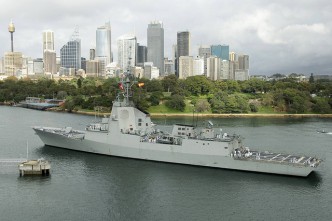
Spain's F100 multi-role Aegis missile frigate ALVARO DE BAZAN arrived in Sydney in March 2007 showcasing the design model for the RAN's forthcoming HOBART Class Air Warfare destroyer project.The latest Defence White Paper and the co-released Future Submarine Industry Skills Plan mark a distinct sea-change (pun intended) in the relationship between Defence and Industry, at least in the field of shipbuilding. If all goes according to plan, Defence and industry will form a partnership in which industry will have certainty of a steady stream of shipbuilding work for several decades, allowing the development and maintenance of a skilled workforce.  In return, Defence believes it will be able to acquire ships at a lower cost because of improved industry expertise and productivity.  This new approach meets many concerns expressed by Australian defence industry, including continuity of work, achieving economies of scale, reducing the costs of continually tendering, forming a long-term partnership with Defence and locking out subsided foreign competition.

The new shipbuilding approach reflects and is part of the Government’s wider program to revive Australian manufacturing industry.  The rationale for this is evident in its title—’A Plan for Australian Jobs‘—with manufacturing jobs seen as particularly rewarding.  The vision is to have innovative industries that deliver highly-skilled and well-paying jobs.

Similarly the focus of the new naval shipbuilding arrangements is long-term jobs.  The White Paper states ‘the Government will… support the Australian naval shipbuilding industry in developing and maintaining a workforce…’ (para 12.53)  The DMO skills plan quantifies the White Paper’s ambition as the retention of some 5000 jobs until at least the 2030s.  The underlying premise is that the rate of shipbuilding in Australia can be adjusted to have a continuous flow of work, avoiding peaks and troughs that necessitate a cycle of growing and then cutting skilled workforces.  This approach is seemingly bi-partisan. Read more

Australian’s new plan has similar intentions and rationale to Canada’s National Shipbuilding Procurement Strategy (NSPS) announced in 2010, which aims to bolster economic growth, support industry, and maximize Canadian jobs.  There have already been some cost increases, delays and capability reductions, but an informed NSPS supporter notes that all defence projects deliver less than promised, are late and over budget so the NSPS shouldn’t be judged too harshly on these matters.

Both countries seek to manipulate the market place to build a viable national naval shipbuilding industry.  In deliberately taking such an interventionist approach and picking winners, several questions arise.  If the driving factor is jobs, is the shipbuilding sector the best place to invest?  The DMO paper observes there are a diminishing number of warship suppliers worldwide, suggesting a sunset industry.  This is particularly evident in the submarine market with ‘the future of current players in the market uncertain’ (p36).  Eschewing purchases from existing firms in this competitive market, Australia will instead apparently invest in creating another submarine maker with an uncertain future.

There are some hopes for export sales scattered throughout the DMO proposal.  Exports can help gain improved economies of scale and continuity of work but might be problematic.  DMO notes several pitfalls; there are significant export restrictions on submarines, the few countries purchasing them want small boats, there are several established manufacturers and the market is distorted by national subsidies (p35-37).  Export sales of any Australian manufactured large submarine appear very doubtful.  The warship market also appears to be languishing. While the designer of Australia’s new Air Warfare Destroyers and Landing Ships is held up as a model, Navantia is government owned (by the Spanish Department of Finance), financially supported and heavily subsidised.

The next fallback is usually opportunities in the civil sector. While civilian shipbuilding is a tough market, Navantia has had some success here.  Spanish shipbuilding at the moment however is having difficulties with disputes with other EU partners over subsidies required to keep the industry commercially viable.

To allow an Australian shipbuilding industry to compete for exports and civil projects, ongoing financial support seems likely to be necessary—a shipbuilding industry isn’t just for Christmas!  A fundamental pre-condition though might be significant export restriction relaxation, but that has the potential downside of worrying countries transferring technology to us, like the US, who could fear leakage of sensitive information or even helping a new competitor.

Stepping down to portfolio level from from the national aim of investing in sustainable job creation, is naval shipbuilding the best industry for Defence to be investing in?  Especially when  the shipbuilding concerned is structures manufacture, rather than the development of the systems that make for effective warfighting vessels.  Is building structures leading edge technology that gives the ADF a war-winning advantage?

Certainly a ship’s combat systems will, but this plan does not focus on that. Australian ships instead use mostly imported combat systems, especially from the US.  The Air Warfare Destroyer project was driven by the acquisition of the Lockheed Martin Aegis combat system, not ship manufacture concerns.  An alternative Australian investment path is suggested by the development by CEA Technologies of leading edge radar technologies that also have export and civil sector opportunities.  Is this a better defence industry sector to support from a war fighting perspective, and is it more viable long-term?

There’s a further alternative.  Rather than picking winners and investing in a particular sector, government support could be more broadly based.  SMEs are often touted as the innovators of the industry, working in leading-edge technologies and often in both the defence and civil field.    As the Defence market progressively evolves and new technologies and demands arise, the inherently nimble SMEs may be a surer bet.  Some—like CEA—might succeed brilliantly. It might amount to deciding whether a broadly based SME support strategy or a narrow all-the-eggs-in-one industry sector basket is the better approach.

The final alternative would be to leave the future of naval shipbuilding to the market. The result might be no naval shipbuilding industry at all, but there’s a school of thought that says that the consequences of that wouldn’t be as dire as the industry’s supporters suggest.  Arguably the Air Force is as technology intensive as the Navy and it seems to maintain advanced capabilities without an indigenous industry comparable to naval shipbuilding.

Economists will doubtless be concerned over the impact on effective competition of the new naval shipbuilding approach.  Before this though there are strategic issues at the national and Defence level.  Is this the best approach or would some more thought yield a bigger return on our investment?

Peter Layton is undertaking a research PhD in grand strategy at UNSW, and has been an associate professor of national security strategy at the US National Defense University. Image courtesy of Flickr user Kookaburra2011.

The Defence White Paper—between the lines

14 May 2013

Chinese People's Liberation Army officers with the Beijing Military Region speak with U.S. Marine Corps Staff Sgt. Travis W. Hawthorne, right, about the M4 carbine during the 2012 Australian Army Skill at Arms Meeting (AASAM) in Puckapunyal, Australia, May 12, 2012. Over the past year, low-level but concerning brinkmanship has continued in the Asia Pacific, with China maintaining the pattern of provocation that emerged following the 2008 global financial crisis. As Ross Terrill put it recently, ‘China is probing on multiple fronts for more space and clout, sustaining quarrels with numerous neighbours who are Australia’s friends’.

Oh wait, that doesn’t sound right. What does the new Defence White Paper say about all this? Let me see… ok, I think I understand. Let me try again.

Over the past year, competing territorial claims in maritime Asia have remained unresolved. This is concerning because these flashpoints increase the risk of both ‘destabilising strategic competition’ and ‘miscalculation’. ‘Australia has interests in the peaceful resolution of territorial and maritime disputes including in the South China Sea in accordance with international law…’ ‘Events in the South China Sea may well reflect how a rising China and its neighbours manage their relationships’. Read more

That’s much better. Everything is 100% accurate, but no one’s feelings are hurt. Bad things might happen, but it will be no one’s fault. Better still, we assign ourselves the role of a concerned but seemingly uncommitted observer. It’s as if we’re having a strategic out-of-body experience. That’s the genius of the 2013 Defence White Paper.

Nowhere is this truer than in its repeated focus on the ‘US-China relationship’ rather than on the more usual preoccupation with ‘the rise of China’. Indeed, the chapter on Australia’s strategic environment has a section called ‘The United States and China’ which discusses the two countries jointly rather than separately. In comparison, the 2009 effort was so crass as to have separate sections entitled ‘US Strategic Primacy’ and ‘The Strategic Implications of the Rise of China’.

Apart from a couple of dissenting voices who see the changed tone as kowtowing to Beijing, the new approach has been broadly heralded as more nuanced and sophisticated than its predecessor.  That might be true, and it might even be more self-consistent, but there’s no denying that it’s also both less frank and less complete. The fact is that, no matter how the document was drafted, it was always going to be a compromise between incompatible outcomes.

In a sense, it probably doesn’t matter, just as the ‘Indo-Pacific’ verses ‘Asia-Pacific’ debate is of little consequence beyond academic circles. Although a generation of students will now be subjected to ‘compare and contrast’ essay questions on the issue, the observed reality is that government’s plans for the ADF have changed very little.

To the extent there’s a causal link between the strategic theology of the initial chapters of the White Paper and the wish list of equipment projects further in, the changed description of our strategic landscape hasn’t made one iota of difference. Of course, that could be explained by duplicity of our part; we tell China what they want to hear, while we quietly draw closer to the United States.  And make no mistake; we have drawn closer to the United States in the four years since the 2009 White Paper.

Of course, the Chinese aren’t falling for any of this. They know that we’re welded to the United States through the alliance, and that our history, values and interests will keep it that way. They also know that we’re hedging—along with others in the region—against the possibility that they’ll use their growing power at the expense of others. They even have a word for this; they call it containment. They also know that our newly found love of regional engagement is all about winning over the half billion souls that live between us and China over to our way of thinking. But the 2013 White Paper leaves sufficient room between what they know, and what we say, to avoid giving them offence. Face has been saved.

Duplicity is nothing new in world of diplomacy. Since at least the 1970s there’s been a streak of disingenuousness in Australian defence rhetoric. The Defence of Australia doctrine was conceived as a replacement to ‘forward defence’ in the bitter years after Vietnam. Not surprisingly, it was a policy that justified retaining a moderate size defence force while limiting our liability to be drawn into future US follies. Up to a point, it was our get-out-of-jail-free-ticket for the Cold War. By focusing on the defence of our continent, notwithstanding the absence of any plausible threat, we could limit expectations of what we were prepared to do elsewhere.

Yet at the same time, we simply rolled on with the force structure from the days of forward defence. We even retained an aircraft carrier until it became too expensive. And, just as we do today, we worked hard to maintain interoperability with the United States and pursued cooperation with them at multiple levels. Critically, we did so not just because we wanted to be able to call on US assistance if something went wrong—though that’s always been important—but also because we knew that the United States underpinned the geopolitical strata upon which our security depends. In reality, irrespective of the careful wording of our policy, there was never much doubt that we’d ‘act to meet the common danger’ as required in article IV of the ANZUS treaty (PDF) if the strategic balance in the Pacific was threatened.

Much has changed between the first codification of the defence of Australia doctrine in 1976 and today. Yet, even though the policy has evolved to be more outwards looking in response to changing circumstances (though mostly as a result of lessens learnt than foresight), the core priority on our own defence remains intact. And what a bloody useful thing it is to have.

To start with, it allows us to set the upper limit of scale of our defence effort at a relatively low level, given the continuing absence of a serious contender to threaten our sovereignty. At the same time, it positions us well to determine the scale of what we contribute to coalition missions such as those in Iraq and Afghanistan. Moreover, because the wording used to describe the self-reliant Defence of Australia was largely plagiarised from Nixon’s July 1969 ‘Guam doctrine’, it’s hard for the United States to object. For these reasons, Defence of Australia remains the policy of choice for free riding.

Perhaps more important for us today, Defence of Australia allows us to adopt the sort of third party once removed rhetorical position employed so cleverly in the 2013 Defence White Paper. Imagine how the White Paper would have read if it had begun with the recognition—brutal yet surely accurate—that our security ultimately depends on the geopolitical balance in our part of the world rather than on our ability to defend the continent against attack.

Duplicity requires careful handling. Not because we might be found out—we’re so far down the ‘they know that we know that they know’ route that there’s nothing to hide. Rather, we need to be careful not to delude ourselves. It would be alarming if our response to the Asia-Pacific century (oops, Indo-Pacific Asian century) was to be to refocus our limited resources on operating aircraft out of bare bases and conducting Kangaroo exercises to hunt for raiding parties in our remote north. God help us if we start to believe our own rhetoric.

Mark Thomson is senior analyst for defence economics at ASPI. Image courtesy of Wikimedia Commons.

Not a lot atoll

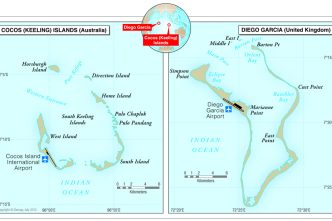
PrintYou can do a lot with a coral atoll. The US uses the leased UK territory of Diego Garcia ‘To provide forward support to operational forces forward deployed to the Indian Ocean and Persian Gulf…’. That includes logistical support for naval and air forces, and makes Washington’s job of projecting power into the Indian Ocean and Persian Gulf regions far simpler one than it otherwise would be.


View Larger Map

The new Defence White Paper confirms the implementation of the ADF Posture Review recommendations to make military use of the Cocos (Keeling) Islands, which lie about 1100 km from Indonesia, and 2100 km from Australia’s North West Cape.

The government will be…

…expanding the capacity of infrastructure to meet Navy’s future basing requirements; and upgrading airbases to better support aircraft operations, including for P-8A maritime surveillance operations from Cocos (Keeling) Islands.

Of course the Cocos are smaller than Diego Garcia. There isn’t the space to provide the same level of logistic support, so we probably won’t see major and permanent bases there. Nevertheless, the position of the atoll will make it a useful operational asset as the Indian Ocean and South East Asian sea lanes take on greater significance.

Andrew Davies is a senior analyst for defence capability at ASPI and executive editor of The StrategistHarry White is an analyst at ASPI.

Beyond the once-over analysis and partisan waffle

9 May 2013

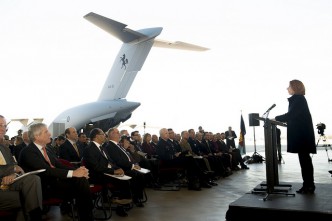
Prime Minister of Australia, the Honourable Julia Gillard MP launches the Defence White Paper at No. 34 Squadron, Fairbairn

Defence White Paper 2013 is well written and largely internally coherent, except for the absence of an investment plan to execute its policy and strategy objectives. It often tries making virtues out of necessities politically, particularly with convenient international schedule delays such as the troubled JSF program.

Much commentary has inevitably concentrated on its recent fiscal and current party-political contexts or, superficially, on major equipment proposals. There is really little substantial change to the major ADF capabilities originally planned in the 2003 Defence Capability Review that updated and corrected the 2000 White Paper.

More tactful and ostensibly optimistic about China than its predecessor, this paper has unfortunately dropped mention of China’s lack of strategic transparency as a cause of instability globally and regionally. It also logically continues the post-Indonesia focus of its 2009 predecessor. Read more

While admirably discussing the general risk of strategic coercion, a capacity to handle such coercion (and not just ‘armed attack’) is, strangely, not prescribed as a principal ADF task. This will cause endless argument among strategic theologians.

Much important contextual background is, however, being missed in discussion of the paper. Strategic security policy is always about minimising general strategic risk, over an often unpredictable future, through various shaping, hedging, deterrence and war-fighting capability measures.

It’s therefore profoundly disappointing to again see so much commentary purporting to explain away reduced defence investment because of a supposed absence of specific military ‘threats’ as the commentator perceives the situation now.

Moreover, beginning with the first White Paper in 1976, none have been subsequently funded as planned. Few commentators have noted that the gap between the investment cited as necessary, and that subsequently delivered, now totals around 6–7 years’ worth of annual budgetary allocations to defence.

Empirical tests are also being ignored. After the 1999 East Timor crisis revealed just how badly our defence capabilities had deteriorated over preceding decades, there was genuine bipartisan agreement that real increases were needed as catch-up investment to rebuild our defence force. But now, only a decade or so later, this lesson has been readily forgotten as politically or intellectually inconvenient. Particularly by many economists when trying to justify the large cuts to defence investment in last year’s federal budget. And not just by economists in much of the discussion about this White Paper.

ASPI analyses continue to show that lower but sustained investment in defence would cost less over time and generally deliver better defence capability and strategic coherence. The cyclic requirement to eventually claw back defence capabilities of all types―after they’ve been hollowed out, not maintained logistically, not updated technologically or have been dispensed with because of policy fads―is needlessly expensive.

There are few or no votes in defence issues, at least until it’s too late, whereas electoral advantage is continually tempting where social security, health, education and law & order issues are concerned. Much White Paper commentary is consequently prone to assuming that defence investment is somehow ‘discretionary’, when this is often a politically expedient rather than an objective decision.

Defence remains the only major governmental responsibility not shared with the states and territories. It’s also essentially a long-term, above politics, national interest responsibility. As Australians increasingly expect the federal government to solve all their problems, defence investment is increasingly squeezed structurally. It’s now just often simply assumed, wrongly, that defence investment can be cut year by year with no resulting long-term cost. Yet proposals such as Gonski and the NDIS are never expected to face the same fiscal realities or implementation scrutiny.

Little of the discussion about Defence White Paper 2013 has acknowledged that the future Australians affected by prolonged lower defence investment now―through greatly heightened strategic risk or worse over the long term―don’t get to vote now to prevent or mitigate it. Some aren’t even born yet. This temporal accountability deficit means short-term political expediency continually wins out over responsible long-term governance in the national interest.

Despite the hoopla when each White Paper emerges, they remain a fundamentally flawed process for developing policy, strategy and capability. Not least because they’re declaratory policy rather than what Australia really thinks and does. A return to formal intelligence estimates and strategic appreciations which procedurally exclude politically-driven subjectivity would produce much better results.

The out-of-schedule publication of this White Paper in an election year also greatly limits its strategic utility and credibility internationally. Foreign customers will surely tend to wait for the next one following what they expect will be a change of government this September.

Only the 1987 White Paper was published (early March) in an election year (mid July). But this was essentially a governance decision rather than driven by party-political considerations. It came 13-years after the previous White Paper, amid unusually bitter infighting within the Department of Defence that needed resolution, and occurred in the middle of a long period of government by one side of politics.

This White Paper hasn’t been tabled in Parliament (as were all its predecessors bar 2009). The worth of the document is intrinsically diminished by avoiding the discipline inherent in immediate and longer-term parliamentary scrutiny. Especially as there’s been no bipartisan team-led community consultation process as occurred with the 2000 and 2009 papers.

If after all this you still doubted that Defence White Paper 2013 is a politically-motivated document, its public launch surely proved otherwise—especially the considerable disregard shown for the conventions preserving the necessary apolitical role of our defence force. Misusing ADF personnel as a television backdrop for ministerial speeches was particularly inexcusable.

Finally, prominent Labor defence experts, across all factions and all leadership support groups, privately express deep frustration that two generations of effort is being thrown away so senselessly. Particularly the long rebuilding of public confidence that Labor was sound on strategic security issues after the polarisation of the Vietnam era. Only their party loyalty, intensified even further by Labor’s minority government situation in an election year, has kept the lid on public dissent.

Neil James is executive director of the Australia Defence Association. Image courtesy of Flickr user Julia Gillard.

Ah the serenity: DWP13 and the view from Canberra and DC

8 May 2013

The vista from the White House is very different from the “serenity” that is seen from the front lawn of the Lodge. This is evident in Andrew Smith’s post DWP 2013—what will the Americans think?. Andrew provides an important take on the new White Paper and how it matches ‘US vital interests’. What it also highlights is that there is a big difference in strategic interests between regional middle powers and global superpowers.

Andrew’s take on the nexus between US and Australian interest hinges on the White Paper’s heavy regional focus. As he quite rightly states, despite the ‘pivot’ / ‘rebalance’ Washington cannot overlook that fact that it has ‘global interests and responsibilities from which it can’t resile’. Andrew’s major concern is the Middle East. The continuing US engagement with this region is smartly captured by the Lowy Institute Executive Director Michael Fullilove, who has made reference to “Obama’s ‘Michael Corleone moment’” from The Godfather III: “just when I thought I was out, they pull me back in.” Read more

For a regional power like Australia the ‘pull’ of the Middle East is nowhere near as strong especially as the shift of global economic weight and strategic competition moves closer to home in the Indo-Pacific region. It is also a clear reflection, as Section 3.58 of the new White Paper outlines, of the “limits of our capacity, given the priority of our other tasks.” (See also Section 6.17 of the 2000DWP (PDF) and Section 3 of the 2009DWP) (PDF).

This is not to deny that Australia has interests in the Middle East. But throughout its history Australia’s commitment of military force to this region has always been dependent on a stable Asia-Pacific, one that is largely devoid of tension and major strategic competition. Not only that, but when it has gone to the Middle East it has followed its great and powerful friends, who themselves have been guaranteeing Australia’s maritime security in Asia.

During WWI we waited until the German fleet and possessions in the Pacific were no longer a threat before sending the AIF overseas. From 1940–42 we committed to the Middle East on the principle of Imperial Defence and British assurances over the Singapore Strategy. US primary in Asia provided the backdrop to our commitment of forces to the First Gulf War, Iraq and Afghanistan. As competition in the Indo-Pacific rises the likelihood of a significant ADF deployment to this region declines.

The Middle East may well be “the western shoulder of the Indo-Pacific.” But such an interpretation of this concept is too broad. The White Paper narrows this strategic region to “India…looking East” (Section 2.14) and, more specifically, to the fact that it “adjusts Australia’s priority strategic focus to the arc extending from India though Southeast Asia to Northeast Asia.” (Section 2.5)

At the epicentre of this arc is Southeast Asia.

The focus on Southeast Asia is both crucial and overdue. Southeast Asia is the connecting point of this “new Indo-Pacific strategic arc” (Section 2.4). This region has been a magnet for Australian strategic interests whenever competition in the Asia has increased. From the Singapore Strategy in the 1920s and 30s, to the Indonesian Konfrontasi in the early 1960s and the establishment of the Five Power Defence Arrangements as well as the Cold War conception of a domino theory that drove the strategy of Forward Defence and saw Australia commit forces with the United States to South Vietnam.

Underscoring Australia’s engagement in this region from 1950s and 60s has been the US Alliance. While some may quibble over the language of the 2013 White Paper in relation to US primacy in the region, the fact is the Alliance remains the corner stone of our national defence policy.  The reaffirmation of the US Alliance (with a capital A) in the 2013 White Paper sits alongside recent moves that include the appointment of Major-General Rick Burr as Deputy Commanding General (Operations), US Army Pacific, the potential for B-52 bombers to start operations out of the NT and the move to send HMAS Sydney  to join the US Seventh Fleet in Japan. Furthermore the new White Paper made it clear to the region, including China, that the rotation of US Marine and Air Force assets through Darwin will continue and it left the door wide open for an increased US navy presence staging out of HMAS Stirling (Section 2.25).

But does this go far enough? If the US is looking for burden sharing (and quite rightly they should be) they should be aligning their partners and allies to their regions of interest. While the Southwest Pacific may be of little interest to the US it as critical to Australian national security and as the 2013 White Paper reaffirms Australia’s the long standing approach to this region means that it is  an area of ‘non-discretionary’ operations for the ADF. But this is not all that Australian regionalism offers: the new focus on Southeast Asia is critical to both Australia and the US.

If the US wants to get the most it can out of its alliance with Australia and have it shoulder its share of the ‘burden’ then it is should be less concerned with our presence and role in the Middle East and looking more towards what we proactively offer, in the partnership, in Southeast Asia and into the eastern Indian Ocean, while more broadly, the US should continue to look at how Australia can provide the US military strategic depth in the Pacific.

From the White House steps one has the chance to view the globe and all the vital US interests it contains, from the Lodge the ‘serenity’ for a middle power like Australia looks more like a region much closer to home.

Peter Dean is a fellow at the Strategic and Defence Studies Centre at the ANU. Image courtesy of Flickr user State Records NSW.

The ‘Indo-Pacific’ places Australia at the centre of the action

7 May 2013

The Strategist is giving the White Paper’s newest strategic construct—the ‘Indo-Pacific strategic arc’—short shrift. Peter Jennings suggests it still needs thinking through. Rob Ayson sees it as nothing more than a smokescreen. I’m not sure I can agree with them.

Strategists notoriously crave neat metaphors. This latest one contains echoes of Paul Dibb’s famous ‘arc of instability’ which, with characteristic precision, Dibb used to describe the area to the North and East of Australia (PDF) that ‘stretches from the Indonesian archipelago, Timor-Leste and Papua New Guinea in the North, to the Solomon Islands, Vanuatu, Fiji, New Caledonia and New Zealand in the East.’

This degree of precision has thus far been absent from discussions on the Indo-Pacific. The National Security Strategy (PDF) was unduly sloppy in this regard, asserting that ‘use of the term ‘Indo-Pacific’ complements the term ‘Asia-Pacific’—they’re both useful frames through which to view Australia’s national security interests’. Such an approach served only to undermine the sense of coherence that the Gillard government has sought to achieve by releasing a trio of White Papers in such close succession. Read more

Some Indo-Pacific enthusiasts have used the term quite broadly. In his inaugural SDSC Centre of Gravity paper, for instance, Rory Medcalf of the Lowy Institute saw the Indo-Pacific as ‘encompassing both the Pacific and Indian Oceans, defined in part by the geographically expanding interests and reach of China and India, and the continued strategic role and presence of the United States in both’.

Defence Minister Smith favours a similar broad brush approach, referring to the Indo-Pacific as an amalgam of ‘the Asia-Pacific and the Indian Ocean Rim’. Others adopt a far narrower conception. DFAT Secretary Peter Varghese, for instance, sees the Indo-Pacific construct matching ‘neatly’ with the expanded East Asia Summit. In a recent speech to the Asia Society, Varghese referred to an emerging Indo-Pacific strategic arc that extends ‘from India, through Southeast Asia toNortheast Asia.’

Yet none of these formulations is completely satisfactory. Insufficient strategic interdependence exists between the relatively large and diverse range of countries encompassed in the Medcalf and Smith approaches to justify calling the Indo-Pacific a ‘strategic system.’ For instance, the relevance to Australian strategy of Indian Ocean Rim countries such as Madagascar, Mauritius, Mozambique, Seychelles and Tanzania is presently unclear.

Similarly, there is little substantive difference between Varghese’s narrower Indo-Pacific conception and existing regional descriptors, namely the Asia-Pacific. To be sure, India is arguably not an Asia-Pacific country—a fact reflected by its continued exclusion from APEC. Yet other institutions with a distinctly Asia-Pacific flavor—namely the ASEAN Regional Forum (ARF)—have shown sufficient flexibility here.

Clearly some middle ground between the Medcalf/Smith and Varghese approaches could usefully be found. Before contemplating what that might be, however, it’s important to acknowledge the case for throwing up one’s hands and abandoning the Indo-Pacific term altogether.

While that may seem pointless given that the construct has now officially become part of Australian Defence policy, the White Paper implicitly—and probably quite unintentionally—actually calls its own Indo-Pacific construct into question. The vast majority of the regional flashpoints it refers to, for instance, are concentrated in discrete sub-regions where no clear Indo-Pacific logic applies. Take the Korean Peninsula, East China Sea and Taiwan tensions in Northeast Asia. The fact that these flashpoints are arguably alsoAsia’s most dangerous suggests that this particular deficiency with the Indo-Pacific construct cannot be too readily dismissed.

Likewise, the US-China dynamic that the White Paper suggests will be central to shaping order in the coming decades will be played out predominantly in the Western Pacific. For as Michael Green and Andrew Shearer have recently observed (PDF), American leadership in the Indian Ocean isn’t a core US national interest.

These shortcomings notwithstanding, there is a strong Australian logic for persevering with the Indo-Pacific concept. As the White Paper notes, achieving and influencing strategic outcomes is going to become more difficult for Australia is an increasingly complex Asian security environment.

The Indo-Pacific places Australia at the centre of the action and there is thus some political mileage to be gained from encouraging strategic partners—particularly India and Indonesia—to think about the region in such terms. For regions, above all else, are essentially political constructs. The utility of the ‘strategic arc’ is that it allows us to specify—taking a leaf out of Dibb’s book—precisely where the Indo-Pacific begins, which key players it encompasses, and where it ultimately ends. That’s a useful step forward.

Brendan Taylor is head of the Strategic and Defence Studies Centre, Australian National University.

ANZUS and the new Defence White Paper

7 May 2013

HMAS Sydney, April 2013Last Friday’s Defence White Paper (DWP) rightly drew a lot of praise from (most) of the analytical community and the media. Many commentators, including myself, welcomed the more cautious tone regarding China’s military rise and the dismissal of Australia having to choose between Washington and Beijing. Does that mean Australia is less supportive of our US alliance? I’d argue that exactly the opposite is the case. There are several key points that support my view.

First, being more nuanced about China’s military capacity and intentions shows a maturation of Australian strategic thinking which surely is welcomed in Washington. As it seeks to integrate (not contain) China, Washington doesn’t need alarmist rhetoric about Beijing from its allies. It also doesn’t want us to invest in military capabilities such as nuclear submarines or long-range strike assets which would unnecessarily duplicate theirs and send provocative signals to China. Read more

Second, I disagree with Andrew Smith’s post on The Strategist that the DWP signals to the Americans that Australia’s version of burden-sharing means only securing the Southwest Pacific. For me, the document signals our preparedness to share a larger burden in Southeast Asia and parts of the Indian Ocean. Like previous documents the DWP states that the ADF’s principal task is to ‘deter and defeat armed attacks against Australia’. However, among the military objectives to achieve this task is ‘… project power by deploying joint task forces in the Indo-Pacific region and support the operations of regional partners when required’.

This not only makes for a much wider operational area than just defending the ‘air-sea gap’ between Australia and the archipelagos to our north, it also provides opportunities for joint operations with the US Marine Air Ground Task Force (MAGTF) and US air force contingents rotating through our Northern facilities. Moreover, the reference to ‘regional partners’ raises the possibility of greater ADF engagement in Southeast Asia, which the DWP identifies to be ‘geographic centre’ of the emerging ‘Indo-Pacific system’. It also stresses the importance of improving defence ties with Southeast Asian countries, particularly Indonesia. This is hardly ‘Defence of Australia reloaded’; instead, it reflects the government’s understanding that Southeast Asia is gradually becoming the playground of major power shifts and changing military balances.

Third, that the DWP isn’t about greater independence from the US also becomes clear by its refreshing honesty about the limitations of defence self-reliance. That is, for major military operations beyond the South Pacific we’ll continue to depend on the US. And while the DWP is more conciliatory in tone towards of China, Australian governments will of course remain wary about Beijing’s strategic behaviour, particularly in the South China Sea. As a result, the objective of remaining close to the United States will remain unchanged.

To that end, some procurement decisions in the DWP confirm the trend of closer military relations with our US ally. Australia will be the only country other than the United States to operate the EA-18G ‘Growler’ electronic warfare aircraft, with which Australia could make a very useful niche contribution to US-led operations. Australia also plans to operate at least 72 fifth-generation Joint Strike Fighter (JSF) aircraft, more than any US ally in Asia. The new 12 diesel-electric submarines will also be fielded with a US combat system, which should ensure a high degree of interoperability.

Moreover, on Friday the government also responded to the Australian Defence Force Posture Review.  This included an announcement to ‘work with the United States in identifying mutually beneficial options for improving ADF base capacity and facilities at Darwin and Tindal’. In other words, American B-52 long-range bombers and surveillance aircraft could fly missions from the Northern Territory, providing the US with greater strategic depth. The possibility of future US reconnaissance flights from upgraded airfields on the Cocos (Keeling) Islands, another announcement in the DWP, is also far from being remote.

Finally, just today HMAS Sydney arrived at Yokosuka Naval Base in Japan where she will embed with the US Navy’s 7th Fleet over an extended period of time. Integrating the warship into the George Washington Carrier Strike Group (CSG)—as opposed to usual short-term exercises—is an important development. Again, Australia is the only Asia-Pacific ally to do so. Moreover, the ship will take part in real-world operations in the CSG’s ‘Area of Operations’, which includes the Senkaku Islands where tensions between Japan and China are still running high. By doing so, not only does Australia make an active contribution to US military operations in Northeast Asia, it also signals to China (and Japan) on which side it’s on. The new DWP is therefore hardly an attempt to walk away from Australia’s ANZUS commitments.

Benjamin Schreer is a senior analyst at ASPI. Image courtesy of Defence.

The Defence White Paper’s vague hope

6 May 2013

PM Gillard meets with HE Mr Li Keqiang, Premier of the People’s Republic of China. Ministers Carr, Emerson and Shorten were there. Ceremonial welcome and Witnesses Signing Ceremony . Great Hall of the People, Beijing , Prime Minister Gillard, Overseas visit to China 9 April 2013The Defence White Paper gives an excellent description of the Asia Pacific but is calm about its dangers. It is heartening on the ADF’s capacity to defend the nation and its near neighbourhood and rightly reaffirms ANZUS and the US role: ‘It is unambiguously in Australia’s national interest for the US to be active in our region as economic, political and military influence shifts towards it’. It’s also correct not to name China as an adversary. Saying what we stand for in the Asia Pacific, and how we plan to protect it, is more pertinent than saying who we fear.

But we can’t hide the fact that China is probing on multiple fronts for more space and clout, sustaining quarrels with numerous neighbours who are Australia’s friends. The only reason Australia is not among those nibbled, along with Japan, Vietnam, Philippines, India and others is that’s so far away. This partially justifies the White Paper’s silence, but is short-sighted.

There is no integration of the Alliance with the overall regional picture to manage what is a marked new challenge to the status quo. The White Paper seems reluctant to state the values that bind Australia and its friends together. Stating our values is not provocative. If that’s a message to China, it’s in the eye of the beholder.

The White Paper speaks eloquently of the need to protect prosperity and stability. But where do these two desiderata come from? Long-term stability comes from democracy and freedom of the individual. Prosperity comes through free markets and free trade. Happily, China has embraced the values of economic liberalism to a considerable extent, but they are not Chinese values. Rather they are long-time Western values, and if the US and its allies don’t defend them they might not endure.

Confusion over Japan is related to this point. You can’t talk of the US and China as the two ‘global powers’ and relegate Japan to ‘regional power’. It is not just that in a decade or two the labels might have to be changed, but right now the White Paper’s assessment of power undervalues democracy and free markets in the making of stability.

True, the entire White Paper assumes the centrality of a US-led equilibrium to Australia’s security and prosperity. But it’s content with a vague hope to ‘develop the security structures on our region to help ensure cooperation…’. Lame references to ‘rules of conduct’ and a ‘rules-based global order’ (which doesn’t exist) send no message to Beijing that Australia opposes the weakening of the existing equilibrium in the Asia Pacific. Beijing respects strength more than Western-derived rules of conduct.

Ross Terrill of Harvard’s Centre for Chinese Studies is a visiting international senior fellow at ASPI. Image courtesy of Flickr user Julia Gillard.