Articles by " Natalie Sambhi"

The end of Suharto

24 May 2013
Posted in: General By

Mr. Suharto presented his address of resignation as President of the Republic of Indonesia at Merdeka Palace Jakarta, 21 May 1998.

This week marks 15 years since Indonesian cities erupted in violence in early May 1998. Burdened with economic hardship from the East Asian Financial Crisis and fatigued with political corruption, Indonesians took to the street and, amid clashes with armed forces, demanded an end to Suharto’s 31-year rule. On 21 May, Suharto resigned as president (video) and the New Order was over.

Over the past 15 years, Indonesia has developed in various ways since Suharto left centre stage.

For one, after Suharto’s departure, under a series of reforms during the period known as reformasi, democracy took the place of autocracy. According to Freedom House, Indonesia is currently rated ‘free’ and an ‘electoral democracy’. The country has made substantial gains both in its own right and when compared to other democracies in East Asia like Thailand and the Philippines. As Ed Aspinall sees it, Indonesia is judged as being the most democratic system in Southeast Asia.

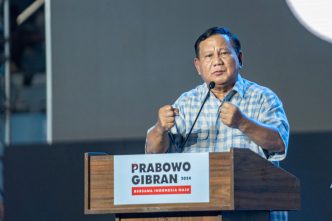
But there is a note of caution to add: conservatives have wound back reforms in electoral management, counter-corruption and minority rights, and there’s no guarantee that civil society can hold back further attacks on reform. That said, taking a long-view, it’s a far more open political system than its predecessor in which few credible political alternatives existed. As we look to 2014’s presidential election, democracy might very well deliver some surprises for us: will Prabowo or the wild card Jokowi make it to the Presidential Palace?

Since the New Order, Indonesia has developed active media that’s currently rated by Freedom House as ‘partly free’. Indonesia’s ‘citizen journalists’ can express their satisfaction (or dissatisfaction) directly and openly to the President—even via his Twitter account. But several of the main news networks are controlled by a handful of players with vested interests, so it remains to be seen whether we can expect independent coverage of the upcoming election.

The military has made substantial strides towards reform, withdrawing from politics and revenue-raising practices. But worries remain. The recent case of Kopassus revenge killings in a Yogyakarta prison raises questions about a culture of impunity and human rights abuses, although relatively swift action by military leaders to reassign those responsible for their soldiers’ actions is a positive sign that TNI is aware of the damage these cases wreak on their perception of a professional military. The establishment of a hotline for public complaints and more talk of military discipline law in the past month alone are steps, even if baby ones, in the right direction. The police needs to follow this move towards greater accountability. Indonesia is still a country with work to do on the rule of law, especially combating corruption and broader reforms to promote a more stable environment for investment.

Lacking large reserves of capital, investment is vital for Indonesia’s continued economic growth. Under the New Order, economic growth steamed ahead at unprecedented rates, at times over 7%. This was the result of a policy of integration with the global market. In some ways it turned out to be a house of cards which came tumbling down in 1997 as Indonesia buckled to the East Asian financial crisis. Since then, the economy has rebuilt and has achieved, on average, a respectable 6% growth over the past few years and is expected to stay around that level.

However, there are concerns that Indonesia’s economy could be let down by a lack of infrastructure, high levels of corruption and slow increases in average incomes. Other economists warn that growth driven by services and commodities might not be enough to sustain high growth rates and that the manufacturing sector requires greater investment. Other ongoing issues include income inequality and increasing fuel subsidies, which also diverts money away from infrastructure investment.

And it remains to be seen how Indonesia’s accumulated riches from its economy will benefit the majority of the 240 million inhabitants of the archipelago. The test case of Jakarta’s newly implemented health care system shows signs of trouble (video) and raises doubts about the viability of programs in towns with fewer hospitals and doctors.

There are other aspects of Indonesia that are at risk of flaring up and undermining its stability. Inter-religious and inter-ethnic violence in areas like Poso in Sulawesi and the threat of terrorism against local targets will require greater attention by security forces.

It’s been a big decade and a half. And at the macro level it’s an almost entirely a good-news story. But, especially for Australia, it’s important to understand that Indonesia’s circumstances at the ground level are more nuanced. Whether Indonesia can be expected to meet our enthusiasm about Asian Century initiatives might depend on its capacity on fixing pressing domestic issues first. Much has changed since Suharto, but some things have stayed the same.

Natalie Sambhi is an analyst at ASPI and editor of The Strategist. Image courtesy of Wikimedia Commons.

Australia–Indonesia relations: all marriages need effort

Group shot of the ASPI-Defence 1.5 track dialogue with Indonesia (photo credit: Luke Wilson, ASPI)The Australia–Indonesia relationship is headed in a broadly positive direction, with the potential for defence and security cooperation to grow. But people-to-people and economic links are surprisingly limited and more needs to be done to build ballast into a relationship often at risk due to misperceptions. These are our personal conclusions after ASPI’s inaugural ‘Australia–Indonesia Next Generation Defence & Security Forum’ in Sydney, 14 to 16 May. With the support of the Department of Defence, we brought together 20 Australian and Indonesian participants from the military, academia, government departments and think tanks for two days of 1.5 track discussion on pressing defence and strategic issues. To encourage frankness, the meeting was held under the Chatham House Rule, so we won’t attribute comments to individuals, rather we’ll offer our own impressions of the meeting.

There were several key themes that emerged from the presentations and discussion. For one, maps made an appearance in several instances—a salient reminder that geography is one of the key forces that necessitates greater Indonesia–Australia cooperation. Some presenters used maps to articulate an Indonesian perspective of our strategic environment and its security challenges. In one case, the visual representation of Indonesia’s archipelagic sea-lanes and their vulnerability to foreign vessels highlighted Indonesia’s need for greater investment in naval capabilities as well as for maritime cooperation.

Several speakers also looked at future prospects for the bilateral relationship. One speaker asked, ‘What should the relationship feel like in 20 years?’, the implication being that national sentiment and the degree of ‘warmth’ each country felt for the other would set the course towards stronger strategic ties down the track. For example, interoperability between our militaries (and even officers serving in each other’s battalions) was proposed as a desirable end. Yet several participants challenged this idea, on the grounds that interoperability entails greater compatibility between our systems than is commonly understood and greater congruence between our respective strategic cultures was still needed. Read more

One issue that spurred particularly heated discussion was Papua which, as Peter and Gary Hogan have previously noted on The Strategist, is an area of potential tension between our countries. While the Indonesian participants acknowledged Australia’s official line of recognising Indonesian sovereignty over Papua, some were wary about our commitment to this position. One speaker noted that although Indonesian officials were aware of the Lombok Treaty’s wording on Papua, regular high-level policy coordination between our sides might assist in making our position even clearer. Others talked about bringing Papua New Guinea into a dialogue with Indonesia to discuss the province and other common strategic issues. What was clear from the sometimes heated exchanges around the table was that such frank discussion reflected the trust and confidence in the room, but this isn’t always apparent in the wider relationship.

As with many dialogues on defence and security in the Asia-Pacific, discussion about the strategic position of China and the United States was prominent. There were diverse views but an opinion common to many was that the US remained central to regional confidence and stability. A number of participants thought that Washington needed to do a better job of explaining its broader strategic purpose. Some also said there needed to be a clearer statement of purpose made for the enhanced cooperation between the US and Australia in our north. Showing that all politics is ultimately local, a number of delegates pointed to perceptions (reportedly held by some in Indonesia) that the US Marine Corps deployment was targeted towards protecting US mining interests in Papua. That proposition would likely bemuse US policy makers in both the Pentagon and State Department, but it points to the deep investment needed to build closer relations and trust.

On China’s rise, many participants are watching developments in the South China Sea very closely, especially with an eye to any potential impacts on the security of sea-borne trade. Many in Indonesia are acutely aware of their country’s growing strategic importance and the way in which geography is creating a greater global interest in the region and its vital sea-lanes. There was deep discussion at the dialogue on how Indonesia should respond to this emerging strategic role. Should Jakarta move away from its traditionally non-aligned approach, or does its current foreign policy settings adequately protect its interests? There was broad endorsement for closer ties with Australia and interest in the possibility that such cooperation might include more joint effort on maritime security. But it would be premature to suggest that there’s widespread agreement as to how the bilateral relationship should be deepened.

One particularly amusing and insightful presentation compared the Australia–Indonesia relationship to a marriage. And if the analogy is right, for reasons of proximity, history, interest and mutual benefit, the case for keeping the marriage of a rather unlikely couple together is very strong: even the best relationships have ups and downs. There remains some cause to wish that the two countries understood each other better but a lack of Indonesian language training in Australia and similarly a lack of a strong Indonesian interest in studying Australia don’t help. But participants agreed that individuals and groups in both countries would continue to highlight differences of interest, if not of values, between the two countries. The challenge for Australia and Indonesia is to learn to love each other with all our faults and differences, rather than to make those blemishes grounds for splitting up.

Peter Jennings is executive director at ASPI, and Natalie Sambhi is an analyst at ASPI and editor of The Strategist. Image credit: Luke Wilson, ASPI.

A first look at the Defence White Paper 2013

3 May 2013
Posted in: General By

The PM and Minister Smith at the launch of the Defence White Paper.

As a first look analysis of the Defence White Paper 2013 (PDF), ASPI will be progressively releasing blog posts over the next couple of hours analysing the paper’s key concepts and capability decisions.

Image courtesy of @JuliaGillard.

ASPI suggests

29 Mar 2013
Posted in: General By and

Australian Foreign Minister Bob Carr meets with President U Thein Sein at the Presidential Palace in Naypyitaw, Myanmar, on June 7, 2012.  Photo: Christopher Davy

There’s been a lot of reflection on Australian blogs and news sites about our role in the Iraq war, so for a change, here’s a piece that examines Iraq’s future political prospects and another that ponders whether Iran was the real victor of the war.

Following on from last week’s visit by Myanmar President Thein Sein to Canberra, Sean Turnell’s latest East Asia Forum post examines two economic reforms that are illustrative of challenges ahead for foreign investment.

Next week we’ll be featuring a post on the complex issues raised by autonomous drones. Here’s a New York Times piece that draws on similar themes including the ethics involved in killing and autonomy.

There’s a fascinating blog post on the barriers to professional military blogging. Cross-posted to CIMSEC, it asks, why is it so difficult to attract Gen-Y thinkers to post about naval warfighting? Here’s a snippet:

The perceived risks and rewards of sharing ideas online have never been greater in an era where the center of gravity in naval warfighting thinking has shifted from the dusty Naval War College Review lying unread on the shelf in the empty wardroom, to the simulator and the blogosphere.

Events

Canberra: What is ‘Abenomics’ and will it help Japan’s ailing economy? ANU is hosting a public lecture by Professor Takatoshi Ito on Tuesday 2 April at 5.30pm, JG Crawford Building.

Melbourne: If you’re interested in the economic relationship between Australia and China, Mr Colin Heseltine, a former Australian diplomat, will talk about strengthening business ties, hosted by AIIA Victoria Thursday 4 April at 6pm, Dyason House.

Is China at a turning point? Hosted by the Asia Institute and the University of Melbourne’s Centre for Contemporary Chinese Studies, Professor Christine Wong, Mr Murray McLean and Professor Ross Garnaut will discuss China’s trajectory on Monday 8 April at 5.30pm, Sidney Myer Asia Centre.

Sydney: the Lowy Institute will be hosting former Prime Minister John Howard who will deliver an address on the tenth anniversary of the Iraq war on Tuesday 9 April, details here.

Indonesia and ‘strategic trust’

26 Mar 2013
Posted in: General By

Indonesia's President Susilo Bambang Yudhoyono and East Timor's Prime Minister Xanana Gusmao at the JIDD. March 20 2013.One of the main features of the Indonesian President’s speech to last week’s Jakarta International Defense Dialogue was the concept of ‘strategic trust’. Admitting this was difficult to define, he referred to it as ‘an evolving sense of mutual confidence between nations – particularly between government and militaries’ that enables parties to work together more effectively and, more importantly, peacefully.

President SBY offered two examples from Indonesia’s own history where strategic trust has been the glue in otherwise shattered relationships: between Indonesia and East Timor (a poignant reference given East Timor’s PM Xanana Gusmão was sitting in the audience), and between the Indonesian government and GAM in Aceh. His message is that it’s something that can bring bitter enemies together very gradually over time, ‘brick by brick’, and it has to reach from top leadership to the bottom rung.

It’s not a particularly radical concept, and it has been bounced around before. But what President SBY has put in words is, for instance, what Australia is seeking to build with regional partners. If we were asking ourselves, ‘what does it take to be strategic partners with Indonesia?’, SBY has got an easy answer: ‘strategic trust’, as it’s understood in Jakarta. And that’s the beauty of abstraction: you’re off the hook proving it in quantitative terms but you certainly can say you’re working towards it. Read more

The President gets further mileage from a term ‘strategic trust’ because it’s entirely consistent with the back catalogue of Indonesia’s regional and international proclamations. Strategic trust is an extension of Indonesia’s foreign policy of ‘dynamic equilibrium’ and its diplomatic approach of having ‘a million friends and zero enemies’. It continues to affirm Indonesia’s desire to be seen as a balancer within the region, not only between global and emerging powers, but also between Asia–Pacific partners. It comes as no surprise that the President would cite opportunities for strategic trust-building as areas where Indonesia has been active diplomatically: in Myanmar’s democratic transition and the South China Sea Code of Conduct.

The speech might not be ground-breaking but it’s clever for slipping a diplomatic buzzword into a forum like JIDD. There’s no doubt ‘strategic trust’ was whispered around the JIDD stalls throughout the day and after. Media coverage of the event has played up SBY’s speech like he was ‘dropping the mic’ on strategic thinking. But at the end of the day, ‘strategic trust’ is a term that, if incorporated into our everyday diplomatic parlance and practice with Indonesia, wouldn’t be a bad thing.

Natalie Sambhi is an analyst at ASPI and editor of The Strategist. Image courtesy of President of the Republic of Indonesia.

ASPI suggests

19 Mar 2013
Posted in: General By and

U.S. Army Spc. Joshua Philbeck plays a video game after getting off guard duty at the Iraqi police station in Buhriz, Iraq, Feb. 15, 2007.As the military modernisation the Asia Pacific continues, Taiwan is now looking at whether it can build its own submarine fleet.

If you’ve seen the movie Argo—the Hollywood version of the rescue of six US diplomats by the CIA and Canadian government—here’s the memoirs of CIA agent Tony Mendez (Ben Affleck’s character) (PDF) on how things really went down.

In the 21st century security corner for this week: An update on the PLA’s UAV program (PDF) from Project 2049, Study on Chinese UAVs, and CSIS’ Peter Singer looks at the growth in capabilities like drones and cyber, and says that Obama needs to take a greater role in articulating norms for their use.

From CSIS we have a report on the nuclear aspect of Sino-US relations. The dynamic, they say, is stable for the moment, but the US will need to accept a Chinese minimum deterrent to keep it that way.

To mark a decade since the Iraq War, Foreign Policy have published a photoessay that looks at an operations journal of a young American lieutenant. The photos and entries depict his perspective of a post-9/11 America and his deployment in Iraq (warning: it’s grittier than most links we suggest).

Events

Canberra: ASPI’s Andrew Davies and Ben Schreer will provide their thoughts on the 2013 Defence White Paper, hosted by RUSI tomorrow, Wednesday 20 March at 5pm at the R1 Theatrette at Defence’s Russell Offices.

Former DFAT Secretary, Mr Ric Smith AO PSM, will be speaking about Australia in a world of change, covering the global shifts in power, the Indian Ocean and other foreign policy issues. Hosted at AIIA ACT’s branch in Deakin, the event is on Monday 25 March at 5.30pm.

Sydney: Executive Director of Human Rights Watch, Kenneth Roth, will deliver a presentation on United Nations Security Council challenges for Australia at the Lowy Institute for International Policy, 22 March at 12.30pm.

Brisbane: Lieutenant Colonel Peter Monks (currently serving in the Australian Army) will address security challenges facing Afghanistan and future challenges for the Australian Army and ADF on Tuesday 26 March at 6pm.

Image courtesy of Flickr user The US Army.

The Strategist editorial team welcomes its newest member

14 Mar 2013
Posted in: General By

As you may have noticed from ‘ASPI suggests’, Harry White has joined ASPI as not only as an analyst but a member of the Strategist editorial team. He has written on issues including defence capability, US strategic policy, Iran’s nuclear program, and Asian security. Harry has masters degrees in international relations from ANU and the London School of Economics. Before joining ASPI, Harry was a research assistant at the International Institute for Strategic Studies, and editor of the blog Pnyx.

ASPI suggests

11 Mar 2013
Posted in: General By and

Arch of Reunification is on the entrance of Pyongyang.Today’s a public holiday in Canberra so we’re taking a short break from regular blogging, but here’s our weekly round-up of news, reports and events in the defence, NatSec and strategy world.

First up, Dewi Fortuna Anwar’s NBR essay provides an Indonesian perspective on the US rebalance toward Asia. Take note of her concerns about the military dimension of the rebalance and Papua, and how Indonesia is hedging between the US and China.

How will sequestration affect the US Marine Corps? Marines Chief General James Amos says it’ll ‘cut into bone’. Troops deploying to Afghanistan will have the required resources, but with Marines deployed to Darwin, we’ll have to see what budget cuts mean for the rebalance efforts here.

Sticking with US defence budget cuts, the US Navy plans to ground four air wings and cancel eight ship deployments to help save the service USD$10 billion. Read more

Analysis from CSIS on the UN Security Council resolution against North Korea this week. And China’s relationship with North Korea isn’t as straightforward as one might think; senior CCP members are wondering whether to ‘keep or dump’ their troublesome little neighbour.

In one of those strange echoes of history, the Falkland Islands are holding a referendum on whether to remain an Overseas Territory of the United Kingdom.

Lost track of all of Asia’s maritime disputes? Feel like you might have a claim to an island or two? This hands-on video summary can help.

Events 

Canberra: Dr Bobo Lo will be talking about China and the world after the 18th party congress, addressing China’s foreign policy influences, bilateral relations and place in the ‘new world disorder’, Friday 15 March at 10am, ANU.

Don’t forget, if you’re interested in a career in national security, defence or intelligence, the Kokoda Foundation National Security Careers Night is on this Thursday 14 March from 5.15pm, register here.

Melbourne:  What is the future of ASEAN? Speaking on that topic will be Indonesia’s Ambassador to ASEAN, HE Gede Ngurah Swajaya, hosted by AIIA Victoria, Australia China Business Council and Baker & McKenzie on Tuesday 19 March 12pm at Baker & McKenzie’s William Street offices.

Image courtesy of Flickr user Mardruck.

The audacity of Jokowi

8 Mar 2013

Jokowi, amongst the people

It’s March 2013, and looking ahead to September 2014—when Indonesia’s new president should be elected—it’s too early to speculate on the result. In fact, we’re not even sure who’ll line up for the race. But last week, ANU’s Marcus Mietzner made a bold prediction; that not only would Jakarta’s governor, Joko Widodo (aka Jokowi) run in the presidential election, but he’d win. Mietzner’s case was compelling, and if Australia has begun to give a Prabowo presidency some thought, it’s worth reflecting on what ‘President Jokowi’ might mean for Australia.

To sum up Mietzner’s presentation, Jokowi will sail to victory with a popularity (buoyed by intense media attention and pop culture appeal) and the hope of the people that no other political figure in Indonesia’s recent history has been ever able to muster. Jokowi hails from a modest background and self-made wealth as a furniture entrepreneur, which has given him a down-to-earth quality and sensitivity to the issues of Jakarta’s poorer residents. For those Indonesians fatigued with the usual suspects in elections, Jokowi makes an unconventional and therefore appealing candidate. He signals the potential for a new chapter in clean politics and accountability—a perspective that opinion polls are now beginning to show. According to one survey, he’s secured 21.2% of votes and leads the race. Read more

But there are still hurdles. The man himself has brushed aside questions of whether he’ll run, shrewdly reminding enquirers that he’s elbow-deep in the city’s issues. And while Mietzner outlined the logical political gains for a nomination by the Indonesian Democratic Party – Struggle (PDI-P), Megawati Sukarnoputri’s party, ‘Ibu Mega’ could, on a whim, save the ticket for herself and take a third run for the top job. Megawati’s husband and PDI-P chief patron, Taufiq Kiemas, has also urged his own party to leave Jokowi out of the race.

But let’s, for a moment, assume the stars align, and Jokowi seizes his chance to ride the wave of popular support all the way to the Presidential palace. That would mean good things for Australia–Indonesia relations. So far, he’s shown a pragmatic approach to resolving issues, first as the mayor of Solo and now the governor of Jakarta. Known for his collaborative and consultative approach, he’s also keen to follow up regularly on decisions and keep the public service running efficiently, with the interests of citizens at the forefront. Last year, he introduced health care for Jakarta’s poor—something unthinkable before his time.

As mayor of Solo, Jokowi avoided a violent confrontation in 2005 with street vendors when plans were announced to remove them from Banjarsari Park. He reached out to their representatives to encourage dialogue. Both sides reached an agreement, with Jokowi offering incentives that provided for vendors’ needs including a new relocation site, public transport, education and training, tax breaks and loans.

Jokowi’s shown he can deftly balance the interests of big business and the little guy, so he comes with the right tools to navigate nationalist pressures in areas like trade—where tensions over cattle trade might remain. Canberra would also be looking to Jokowi with a hopeful eye for pragmatism and dialogue on Papua; although this might be a marginal issue for president responsible for a vast archipelago.

On military matters, Jokowi doesn’t have a long-standing relationship with TNI. But Mietzner believes the generals would fall into line provided Jokowi remains a darling of the people and stays out of their internal processes. It’s less clear how he’d perform on thornier issues like democratic reform or national-level corruption.

On the PR front, part of Jokowi’s appeal is that he’s seen as a civilian reformer, which might present a good opportunity to dispel Australian misperceptions of an ’authoritarian Indonesia’. After eight years of President SBY and 14 years of democratic transition, if the Lowy Institute’s 2011 poll (PDF) is to be believed, there’s still an image problem. It’s not incumbent on Jokowi to fix this, of course, but he might be part of the solution.

But this raises more questions for Australia: if Jokowi’s the ’it’ guy at home, would he be the ’it’ guy on the world stage? How comfortable would Australia be with a popular figure—Indonesia’s equivalent of Barack Obama—next door?

So far, there’ve been no clear indications from Jokowi what his foreign policy would be. And as I wrote earlier in the week, there are still many challenges that could fetter Indonesia’s ascent. As a ‘man of the people’, he could continue therefore to be focussed on domestic issues. Jokowi might even delve into foreign policy where it concerns the treatment of Indonesian workers overseas. Governor of Jakarta is one thing, but being Indonesia’s President is something else entirely. But even as a governor, there are signs of international awareness: he’s held his own bilateral meetings with a number of ambassadors. And what’s more, the international media have seized upon Jokowi’s fame. His political machinery would figure out how to further translate his domestic popularity to an international stage.

This is just one possible scenario of many, and each candidate will come with their own pros and cons. Eighteen months is a long time in politics, but watch Jokowi, no matter what he and others say about his candidacy in the meantime.

For now, reflecting on Jokowi’s immense popularity, pop culture appeal and his can-do attitude, it’s hard to keep the parallels with Obama at bay. Although these parallels are best understated, I’m reminded of an Aeon magazine article which explored the idea of Obama—with his cool and halus composure—as the US’ first ‘Javanese president’. Turning that idea on its head for a moment, as a rockstar candidate that signals an historic, new era in his country’s politics, could Jokowi be Indonesia’s first ‘Obama-esque’ president? Marcus Mietzner’s answer would be: yes, he can.

Natalie Sambhi is an analyst at ASPI and editor of The Strategist. Image courtesy of www.jakarta.go.id.

Indonesia’s complex ascent

5 Mar 2013

How high will Indonesia rise? (Garuda at Monumen Nasional)

I recently had the pleasure of attending the National Security College’s workshop ‘Indonesia’s Ascent: power, leadership and Asia’s security order’ at the ANU. The presentations were delivered as part of a larger publication project that will explore and challenge different elements of Indonesia’s rise. In this Canberra workshop (the other being in Jakarta), the key message of most speakers was that, overall, Indonesia is on the right trajectory but is still grappling with questions of democratisation, governance and security.

Sue Thompson from the National Security College presented a historical overview of Indonesia’s self-perception as a leader and discussed the legacy of colonialism and great power interference in Indonesia’s affairs. Delivered at the outset of the workshop, these historical experiences provided an important framing device for subsequent presentations that explored the potential for Indonesia to assume a more powerful and influential role in the region. Also discussing historical legacies, independent researcher Robert Lowry explored a number of security fault lines in Indonesia—in particular, separatism—that could threaten its ascent if not addressed carefully. Read more

In terms of other domestic challenges, Stephen Sherlock of the ANU’s Centre for Democratic Institutions argued that Indonesia’s present political settings are characterised by a rather lacklustre line-up of presidential candidates and that an incomplete democratic transition would challenge the country’s rise. (In a later post, I’ll provide the flipside to this view on Indonesian politics.) Leonard Sebastian of the S. Rajaratnam School of International Studies in Singapore highlighted other domestic issues, including the security ramifications of poverty, increasing decentralisation, trans-migration (and the ethno-religious tensions it sometimes brings) and lagging security sector reform as a counterweight to overly optimistic views of Indonesia’s development.

Turning to Indonesia’s foreign policy, the University of Melbourne’s Avery Poole looked at the ways in which democracy promotion has both shaped Indonesia’s diplomacy efforts and provided a balance to political Islam. Meanwhile, Mark Beeson (Murdoch University) and Will Lee (University of Western Australia) contended that Indonesia’s increasing democratic character might allow it to engage with other ‘middle powers’ like Australia, although, in practice, this was still limited to issues within the direct national interest. In responding to both presentations, the NSC’s Michael Wesley questioned the extent to which democracy informed Indonesian foreign policy. He argued that Indonesia’s increasingly democratic character hadn’t necessarily convinced the Australian public to warm to our near neighbour—a view supported by the Lowy Institute’s annual poll.

Looking more closely at Australia–Indonesia relations, Derry Habir of Bakrie University in Jakarta urged caution in getting carried away with Indonesia’s rise. In his view, corruption, competitiveness and growing resource nationalism were areas to watch. Together with NSC’s Chris Roberts, he argued that areas of the bilateral relationship like trade needed greater attention but, overall, there was reason to be positive. In terms of generating greater Australian interest at the grassroots level, Roberts even recommended sending newspaper editors to Indonesia to pique their interest.

Leonard Sebastian and I Made Andi Arsana from Gadjah Madah University in Yogyakarta outlined a number of maritime-related issues which are also challenging Indonesia’s rising trajectory, including complex territorial claims and the need to provide security for a vast archipelago and its sea lanes of communication. According to Arsana, the maritime boundary between Indonesia and Australia is one of several issues that must be addressed. Even though maritime boundaries have been settled, their management remains a big issue for the two neighbours in the future. It concerns maritime resource utilisation which requires collaboration between the two countries.

Mark Turner from the University of Canberra rounded off the discussion by raising broader philosophical questions about how we appraise the bilateral relationship. He wondered whether we worried about the relationship as a result of actual indicators or just as a matter of course. (I’d argue it’s probably a bit of both.)

Overall, one of the key messages of the workshop was that, as we rush towards embracing initiatives that hope to bring us closer to Indonesia, we might need to take a step back to better understand the complex nature of our neighbour’s ascent—and the factors that might hold it back. More specifically, this includes what role we might usefully seek to play; it might well be as a diplomatic or trading partner, or how Australia might adjust to a stronger and more influential regional partner. Nevertheless, convening a number of Australian, Indonesian and Singaporean scholars who, in front of an audience of policymakers and practitioners, grapple with these questions is certainly a good start. By consensus, the issues facing our near neighbour aren’t insurmountable, but they are pressing enough that a dose of realism about Indonesia becoming a great power on our doorstep is needed.

Natalie Sambhi is an analyst at ASPI and editor of The Strategist. Image courtesy of Flickr user drhenkenstein.

ASPI suggests

4 Mar 2013
Posted in: General By and

President Barack Obama attends a meeting in the Roosevelt Room of the White House, Jan. 28, 2013.

Welcome back for our weekly round-up of news, reports and events in the defence, NatSec and strategy world.

It’s one minute past midnight, as the sequester—USD$1.2 trillion of cuts across the US federal budget over the next decade, including defence—has gone into effect. Expect more bickering to follow, writes The Economist.

For readers interested in strategy, Adam Elkus has a short and sweet review of a new edited volume by John Andreas Olsen and Colin Gray called The Practice of Strategy: from Alexander the Great to the present which asks the fundamental question, is there unity to all strategic experience?

There’s cautious optimism from Trita Parsi in this piece on recent negotiations over Iran’s nuclear program; the meeting in Almaty saw the paradigm of the talks shift from perpetual escalation to an exchange of concessions and incentives.

On a related note, why eliminate nuclear weapons? James E. Doyle has a new Survival article available free for download here. Read more

As part of a Yearbook pre-launch series, SIPRI has recently announced that arms sales of the top 100 companies have decreased in 2011. And here’s a list of the top 100 arms-producing companies, excluding China.

Updated: Two of our ASEAN neighbours, Malaysia and the Philippines have been drawn into resolving skirmishes that have resulted in the deaths of 14 Filipinos and six Malaysian police officers. Here’s a quick summary: according to media reports, the violence was sparked when dozens of followers from the Sulu sultanate in the Philippines sailed to Borneo 9 February to claim the Malaysian territory Sabah on the grounds of ancestral rights. Although leaders of both countries have called for an end to hostilities, the stand-off continues. For more detail, Reuters has looked at oil interests of major firms in Sabah, Former Philippine President Fidel V. Ramos has provided his analysis and Fairfax’s Lindsay Murdoch has examined the ramifications for Malaysia’s elections if violence continues.

If you’re researching the conflicts in Iraq or Afghanistan, RAND has a new report that measures US troops deployments in terms of service and length.

Events

Canberra readers, register now for ANU’s 2013 Myanmar/Burma Update Conference, Friday 15 to Saturday 15 March. It features panels addressing democratisation, political and economic issues, ethnic conflict, and the role of the security forces, and for the first time, a Burmese-language session.

Professor Tessa Morris-Suzuki will be speaking about Japan’s second Abe government and its implications for the Asia–Pacific region. Hosted by AIIA ACT, it’s on Wednesday 13 March at 5.30pm.

If you’re interested in a career in national security, defence or intelligence, head down to the Kokoda Foundation National Security Careers Night on Thursday 14 March from 5.15pm, register here.

For Sydney-siders, Paul Barratt AO and Dr Sue Wareham OAM will be addressing the question, why did we go to war in Iraq? Hosted by the AIIA NSW, it’s on Tuesday 12 March at 6pm.

Image courtesy of Flickr user The White House.

Australia and Indonesia’s 2+2 dialogue: room for one more?

27 Feb 2013

Room for one more? Senator the Hon Bob Carr, HE Dr Marty Natalegawa (Indonesian Foreign Minister), HE Dr Purnomo Yusgiantoro (Indonesian Defence Minister) and Defence Minister Stephen Smith address media following the inaugural Australia-Indonesia 2+2 Ministerial Dialogue in Canberra on 15 March 2012.

There’s been talk lately about building our relationship with Indonesia beyond the usual military exercises and defence engagement. But while government statements like the National Security Strategy have emphasised building security ties via the Lombok Treaty, developing the overall relationship (as called for in the Asian Century White Paper) might begin to include more discussion on economic matters. In fact, that’s something that both Australian and Indonesian leaders have flagged at past summits, and the direction in which Indonesian Chamber of Commerce (amongst other Indonesian voices) would like to see the bilateral relationship go. So if we’re serious about moving the relationship forward, then why not a 3+3 dialogue?

The 2+2 dialogue is a newish forum held annually between the Australian foreign and defence ministers and their Indonesian counterparts. A 3+3 could broaden the agenda by adding the Trade Minister (a natural inclusion given DFAT’s structure) or the Treasurer. While the foreign minister bears responsibility for raising trade issues in the context of the 2+2, having a trade minister in person means the ability to address the specifics of ideas and discussion around the table. But while there might be appetite for more bilateral cooperation opportunities, the test of whether it’s worth adding more acronyms (or numbers) to the alphabet soup is really weighed up in terms of process and substance.

In terms of process, aligning six busy ministerial schedules will be no easy feat. The 2+2’s precursor, the Australia–Indonesian Ministerial Forum (AIMF), which lasted from 1992 to 2008, had to muster around 11 or 12 ministers at a time. But the logistics toll can be eased when you think of the number of smaller, more focused meetings that could be held along the sidelines of a larger forum. And there’s diplomatic mileage to be gained by expanding the 2+2 in a way that more meaningfully reflects our aspirations with Indonesia. In the coming years, there’ll be a lot of business sector as well social and cultural initiatives flourishing under the auspices of the Asian Century White Paper but it’s still crucial for high level talks to grow in symbolic terms. Read more

Turning now to substance, a 3+3 might mean cutting back on the time spent talking about strict foreign affairs and defence matters, and discussion might become rather formulaic. But discussion of trade security challenges with the presence of all three ministers more adequately reflects the intertwined nature of our strategic interests, our respective national security plans and the evolving nature of economic linkages in our region. There’s a natural overlap between issues of security and trade; illegal fishing—an issue high on Indonesia’s agenda—is an example where defence capability and trade imperatives intersect. The Lombok Dialogue, after all, was a product of the AIMF.

It doesn’t even have to be confined to the Trade Minister. Perhaps the Minister for Defence Materiel could explore greater defence industry partnerships, especially in light of Indonesia’s push to revitalise its arms industry. The Minister for Education could sound out options to work with Indonesia to help it compete better regionally (it’s something ANU’s Indonesia Update Conference looked at in detail last year). In the opposite direction, Indonesia could help address our apparent Asian language literacy deficit.

Similarly, the Attorney General or Minister for Agriculture, Fisheries or Forestry could add plenty of value. On the Indonesian side, the Coordinating Minister for Legal, Political and Security Affairs could attend. Whatever the configuration, it’s about appraising the ends and means and deciding what would bring both partners the most dividends. And most of all, it’s about getting closer to a comprehensive bilateral partnership.

Of course there’ll be challenges in trying to coordinate three ministers a side, let alone four or five. And with the collapse of the Australia–Indonesia Ministerial Forum after 2008 and the 2+2 just off the ground, there’ll be, understandably, bureaucratic reluctance about going down that path again. But with both sides expressing great willingness to work together and so many areas of potential high-level cooperation, there are good odds of survival for this kind of configuration, if it’s given half a chance.

Natalie Sambhi is an analyst at ASPI and editor of The Strategist. Image courtesy of the Australian Minister for Foreign Affairs.