Articles by " Ross Terrill"

Why does China spook the world?

16 May 2013
Posted in: General By

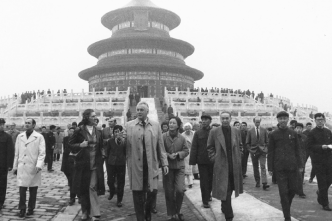
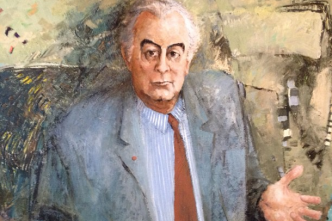
Prime Minister E. G. Whitlam and Mrs Whitlam in front of the Temple of Heaven, Beijing, during Whitlam's visit to China in 1973.Former foreign minister Hayden said, “As Labor came to office in 1972 ‘China’ had become a symbol of a broad judgment of the need for change in many areas”. Stephen FitzGerald recalled of the atmosphere when Whitlam chose him as the first ambassador for Beijing: “I felt part of a movement for social change”. China is often erected as a symbol of a progressive golden age. And occasionally, by Americans, also as a symbol of adverse forces. Such abstraction is a perilous approach to the reality of China.

Japan helped pioneer China as a symbol in the 18th century, portraying it as giving non-Western meaning to Japan’s own existence. Russian thinkers in the same century took China as a symbol of virtue on the grounds that the Western Enlightenment esteemed Confucian China and therefore Russian intellectuals should too.

Throughout the 1960s and 1970s and even today, the left in the west has erected China as a symbol for western guilt over imperialism (a stance useful to Beijing). In Japan, the left’s massive (unsuccessful) struggle against the US alliance in 1960 elevated China as the ‘anti-US’, and thus as brother to a Japan smothered by the American embrace. Today, China is popular among American intellectuals as a symbol of the west’s decline. Such declinists embrace the absurd Martin Jacques’ notion (in ‘When China rules the world’) that ‘China’s past is a symbol of the world’s future’. Read more

Today some Australians erect China as a symbol of a dawning Asian Century. I was asked in a radio interview this morning if China is the key to the Asian Century envisaged by PM Gillard. Such a question overlooks the challenges Beijing faces with many tensions, territorial disputes and contradictions with other countries in Asia (more than it has with Europe or the US). Beijing would have a tough time presiding over Asia and its history in Asia should give pause to folk who welcome China as replacement for the US in the Asia–Pacific. China was intermittently an imperial power in East Asia, not least in the climactic Qing Dynasty.

During the Marshall Mission to China in the 1940s which sought to reconcile Mao Zedong and Chiang Kai-shek, General Marshall’s chief aide wrote home to his wife from Nanjing: “It seems that for time beyond man’s recollection, China has been the desire and design of people outside China. What that has to do with China, as China is today, is another question, but the fact remains that many nations have their eye on this place out here”. In truth, China isn’t a symbol of anything; it’s just multifaceted China. It’s hazardous to essentialise China into a symbol of guilt, hope or fear.

If we’re to choose a context for China’s rise, the best might be ‘modernising China is a major ingredient in globalisation’. The coincidence of enlightened post-Mao Chinese development policies and growing international economic interdependence is of great historical importance to the Asia Pacific. This actual China is distant from the ‘China’s past’ that Jacques calls the world’s future. Refreshingly, China’s current renaissance draws on ideas and resources from around the globe and across the political spectrum. China’s new civilisation will be one ingredient in globalised evolution, but not its heart. China‘s urban youth by no means focus on China’s past; why should Australian youth do so? The 21st century will not be China’s; it will not be any one country’s. That is, unless globalisation stalls, technology goes to sleep, and young people cease to trend cosmopolitan.

This post is excerpted from the author’s ASPI Strategy report ‘Facing the Dragon: China policy in a new era‘.

Ross Terrill of Harvard’s Centre for Chinese Studies is a visiting international senior fellow at ASPI. Image courtesy of DFAT.

The Defence White Paper’s vague hope

6 May 2013

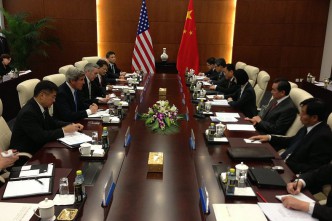
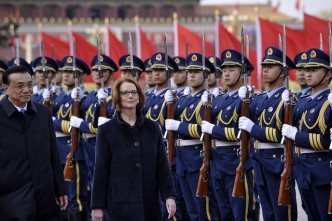
PM Gillard meets with HE Mr Li Keqiang, Premier of the People’s Republic of China. Ministers Carr, Emerson and Shorten were there. Ceremonial welcome and Witnesses Signing Ceremony . Great Hall of the People, Beijing , Prime Minister Gillard, Overseas visit to China 9 April 2013The Defence White Paper gives an excellent description of the Asia Pacific but is calm about its dangers. It is heartening on the ADF’s capacity to defend the nation and its near neighbourhood and rightly reaffirms ANZUS and the US role: ‘It is unambiguously in Australia’s national interest for the US to be active in our region as economic, political and military influence shifts towards it’. It’s also correct not to name China as an adversary. Saying what we stand for in the Asia Pacific, and how we plan to protect it, is more pertinent than saying who we fear.

But we can’t hide the fact that China is probing on multiple fronts for more space and clout, sustaining quarrels with numerous neighbours who are Australia’s friends. The only reason Australia is not among those nibbled, along with Japan, Vietnam, Philippines, India and others is that’s so far away. This partially justifies the White Paper’s silence, but is short-sighted.

There is no integration of the Alliance with the overall regional picture to manage what is a marked new challenge to the status quo. The White Paper seems reluctant to state the values that bind Australia and its friends together. Stating our values is not provocative. If that’s a message to China, it’s in the eye of the beholder.

The White Paper speaks eloquently of the need to protect prosperity and stability. But where do these two desiderata come from? Long-term stability comes from democracy and freedom of the individual. Prosperity comes through free markets and free trade. Happily, China has embraced the values of economic liberalism to a considerable extent, but they are not Chinese values. Rather they are long-time Western values, and if the US and its allies don’t defend them they might not endure.

Confusion over Japan is related to this point. You can’t talk of the US and China as the two ‘global powers’ and relegate Japan to ‘regional power’. It is not just that in a decade or two the labels might have to be changed, but right now the White Paper’s assessment of power undervalues democracy and free markets in the making of stability.

True, the entire White Paper assumes the centrality of a US-led equilibrium to Australia’s security and prosperity. But it’s content with a vague hope to ‘develop the security structures on our region to help ensure cooperation…’. Lame references to ‘rules of conduct’ and a ‘rules-based global order’ (which doesn’t exist) send no message to Beijing that Australia opposes the weakening of the existing equilibrium in the Asia Pacific. Beijing respects strength more than Western-derived rules of conduct.

Ross Terrill of Harvard’s Centre for Chinese Studies is a visiting international senior fellow at ASPI. Image courtesy of Flickr user Julia Gillard.

Obama’s mindset

15 Mar 2013
Posted in: General By

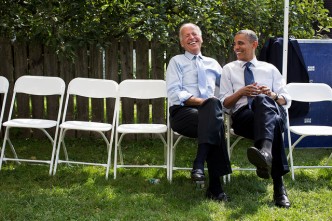
Where's Obama's foreign policy mind at?What lies ahead for US policies affecting Australia? Paradoxically, the greatest doubt about America’s strength in the world comes from within the US itself. Obama’s second term foreign policy will probably resemble his 2008 campaign and the early part of his first term. In other words, Obama will mainly focus on domestic policy. His vision as a student, law scholar and politician in Chicago was about transforming America, not about the world. He believes the American people favour that priority. His first term frustrations in foreign policy will hardly change his view. In four years, Obama soothed international perceptions of the US in some international quarters and entered no major wars. Give him credit for that. But he transformed no world hotspots. A handicap is his worldview that sidesteps the notion of clashes of interest among nations, and encourages a multipolar world in which Washington talks with everybody about whatever, hoping that if big powers disarm, rogue states will be inspired to follow. This view is decidedly not shared by Beijing, the major world capital of most concern to many Australians and most Americans. Moreover, Sudan, Iran, North Korea and others have been slow to heed Obama’s call to rectitude. Yet he’s extremely unlikely to return to Bush’s big stick approach and pro-democracy sermons. Read more

Obama is content to sit at the table of world politics, listen to all, and pluck harmony (he hopes) from a cacophony of voices; a light American footprint will be available but only a last resort. China, though authoritarian, seems more realistic and focused on its goals, and the difference between the two powers’ mindsets should worry Canberra. Obama wants to be universally liked, but that never happens with a US president. He seeks multilateral solutions in a world that seldom delivers them. His idealism ebbs into wishful thinking. Accordingly, one of his aide’s characterised his style as ‘leading from behind’.

Australian social democrats rightly sense a fellow feeling with Obama. In his multilateral rationality he resembles Whitlam and other Labor figures. Grand gestures are irresistible to such leaders; Whitlam freed New Guinea, recognised an unwitting North Korea, wanted to start a government newspaper and carved up the pie as if the Australian purse was limitless. Obama has said his cause is to bring the Kingdom of God on earth, lower the sea levels, and ‘spread the wealth around’. His second inaugural speech emphasised gay rights and climate change more than national security. Only the pressure of events is likely to constrain Obama to resolutely safeguard sea lanes and free trade, protect integrity of the Internet and buoy Washington’s true friends.

Ross Terrill of Harvard’s Centre for Chinese Studies is a visiting international senior fellow at ASPI. Image courtesy of Flickr user The White House.

The United States’ persistent hope for China

7 Mar 2013
Posted in: General By

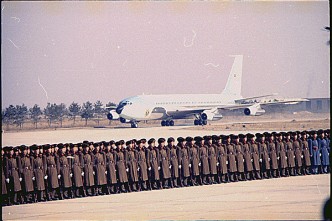
Arrival of Air Force One in Peking, 02/21/1972Based on what they read in the national press or hear the talking heads on TV say, Australians could be forgiven for thinking that the Americans and Chinese are totally at loggerheads. We keep getting told at Australia has to choose between the two. And, to be fair, there are China Hawks in Washington who seem to regard the Chinese with the deepest suspicion, and China’s state controlled press frequently invokes American efforts to thwart Chinese interests. In fact, the situation is far more nuanced than those views would tend to suggest. Seen over a very long period, there is an American view of China that is much more sympathetic, and there is no shortage of American thinkers rooting for a Chinese success story in the twenty-first century.

Americans have a resilient hope in China, and they feel a special rapport with the Chinese. The origins of this trait lie in Christian missionaries being the first Americans to live in China, reinforced in the period of the Open Door Notes, when Americans had superior motives, they believed, in upholding Chinese sovereignty in the face of European colonialism. Canberra’s first-ever diplomat based in China, Keith Waller saw the syndrome in Chongqing during World War II: ‘There was a romantic side to Roosevelt’s attitude to the Chinese stemming, I suppose, from the renunciation of the Boxer indemnity.’ Waller’s skeptical Australian eye watched the missionaries in Chongqing: ‘They used to send [to mission headquarters in New York] regular and pretty glowing reports suggesting that with a little more effort the great nation of China would become Christian… this was undoubtedly a major factor in the American tenderness towards China.’

The persistent hope is indeed remarkable. The 1898–1901 Boxer Rebellion shot down US hopes for a cosmopolitan China; a realisation dawned that China, after all, was different from the US Tiananmen 1989 was even worse than the Boxers, this time the villain was not Chinese culture, but Leninist dictatorship. Yet neither upheaval nor others in between cancelled American’s hope toward the Chinese. Read more

Fuelling the hope is unconscious alignment of American values with universal values, allowing Americans to believe China needs what the US offers. It needed the gospel preached by American Protestant missionaries from the early 19th century. It needed American educational expertise and facilities from the late 19th century to advance its lagging society. Certainly Chiang and Mao needed US help to beat back Japan’s invasion in the 1930s and 1940s. Chiang needed a reluctant US to help against Mao’s assault in the late 1940s. Tibet, an unwilling part of the PRC, felt it needed the US to help protect its religion and culture from Beijing. Endangered by the Soviet Union in the 1970s, China needed the USA as a balance. Departing from Maoism during the 1980s, the Chinese needed American capital, know-how, and markets.

Throughout this span of history, the American side was the masterful player, the presumed source for China’s requirements. The US was mostly willing and able to help. Has the need and capacity abated? Considerably. But atavistically it exists in diffused form. Today American technology, sports, and popular culture are lapped up by Chinese. Steve Jobs, Lebron James, and Lady Gaga are ‘needed’ by young urban Chinese. If the ‘special rapport’ is substantially in the American imagination, an indirect ‘rapport’ does come from the unwitting American impact on Chinese individuals. Seldom, however, does all this affect Beijing’s policy toward the US.

In truth American feelings about China are not only a matter of ‘soft power,’ but a function of geopolitics. A great naval and air power, the US also possesses a huge landmass and looks with fascination at distant China, the continental centrepiece of Asia. For Americans the Pacific Ocean affords China an aura and sometimes an illusion. Neither is shared by Japanese, Russians and others much closer, who act and react toward China but seldom dream about it.

Australians generally resist this American psychology. On leaving Washington in February 1972, Nixon compared his visit to China with his countrymen’s voyage into space. At a refueling stop in Guam he said to the crowd: ‘Join me in this prayer, that with this trip to China a new day may begin for the whole world.’ No such religious or cosmic imagery on China policy came from Whitlam when I accompanied him to Beijing in 1971, or has come from any Australian leader (unless it be Hawke) since. Nor, for multiple reasons is Australia likely to demonise China as occasionally has happened with the US.

Ross Terrill of Harvard’s Centre for Chinese Studies is a visiting international senior fellow at ASPI. Image courtesy of Flickr user The US National Archives.